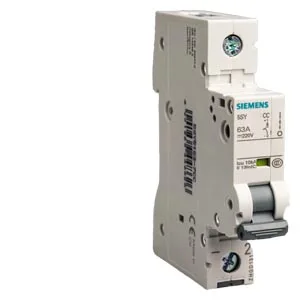
DC-rated MCB for control-circuit protection
Rated 0.3 A at 35 °C, it derates to 0.21 A at 55 °C — the thermal curve matters when the breaker shares a crowded DIN rail with heat-generating devices. The DC breaking capacity is 10 kA at 220 V DC per IEC 60947-2, with a maximum operating voltage of 250 V DC.
DIN-rail footprint and integration
The quick-assembly fastening system lets you snap it onto the rail and remove it with a screwdriver without disturbing adjacent devices. Mounting position is any — vertical, horizontal, or flat — which helps when laying out a dense panel where rail orientation varies. Touch protection is built into the design (IP20 with connected conductors), so a screwdriver or finger can't contact live parts when the breaker is wired.
If your circuit has purely resistive loads or very low inrush, a B-curve would trip faster on overload; if it drives high-inrush transformers or large capacitor banks, a D-curve might be needed to avoid nuisance trips. This 0.3 A rating is sized for low-current control circuits, not main power feeds. Temperature derating is significant: at 35 °C the breaker carries 0.3 A, but at 55 °C it's down to 0.21 A — a 30% reduction. If the breaker sits next to a warm power supply or in a non-ventilated enclosure, size the load at the ambient temperature it will actually see, not the 35 °C reference point. The DC polarity must be observed — the supply cord position requires polarity consideration. On a DC bus, wiring the line to the correct terminal ensures the arc-quenching mechanism works as designed. Reverse polarity won't damage the breaker but can reduce its interrupting capacity.