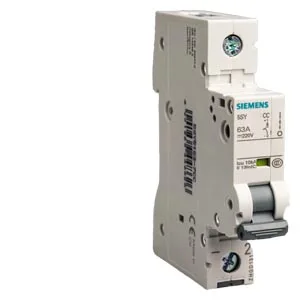
The Siemens SENTRON 5SY5115-7CC11 is a 1-pole miniature circuit breaker rated at 1.6 A with a C tripping characteristic, designed for universal current operation — it handles both 220 V DC and 230/400 V AC circuits. This part is explicitly built for railway applications, carrying vibration resistance per IEC 60068-2-6 (±1 mm at 5 to 25 Hz; 50 m/s² at 25 to 150 Hz) and an operating temperature range from -40 °C to 75 °C.
This is not a standard AC-only MCB repurposed for DC — the 5SY5115-7CC11 is designed from the ground up for DC rail auxiliary circuits. The 220 V DC rating (250 V DC max) with polarity-sensitive connection means it expects the supply cord on the correct terminal; the datasheet marks polarity. The C-curve (5-10x In magnetic trip) suits moderate inrush loads like contactor coils, relays, and small DC-DC converters common in train auxiliary systems. The quick-assembly fastening method and any mounting position simplify panel integration. IP20 with connected conductors is typical for enclosed distribution boards; no washdown rating here, as it lives inside a sealed railway enclosure.
The 10 kA DC breaking capacity at 220 V per IEC 60947-2 is the figure that governs fault protection in a DC auxiliary bus. In a railway context, the battery-backed 110 V or 220 V DC bus can deliver substantial fault current from a bank of traction batteries — this breaker needs to clear that fault before the upstream battery fuse or line breaker operates. The C-curve avoids nuisance tripping on the capacitor inrush of a DC-DC converter or the pickup current of a holding brake. The vibration resistance (±1 mm at 5-25 Hz; 50 m/s² at 25-150 Hz) matches the EN 61373 category 1 class B requirements for railway equipment mounted on the bogie or car body. If the breaker is going into a trackside cabinet or a locomotive electrical bay, this spec confirms it won't trip from vibration alone.