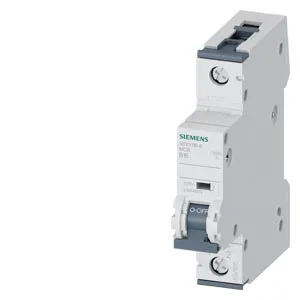
It carries a 10 kA interrupting rating under IEC/EN 60898-2, and the same part also meets UL1077 for North American supplementary protection. The breaking capacity bumps to 15 kA when applied per IEC 60947-2 at DC, so it handles tougher DC bus faults if you're feeding a drive or a control transformer. Rated for 400 V AC (single- or multi-phase) and 220 V DC, with a maximum DC voltage of 250 V. The operating frequency is 50/60 Hz. This is a universal-current device — it works on AC and DC alike, though the DC polarity matters at the terminals; the datasheet calls that out. The IP20 rating is standard for an MCB with conductors connected; it's not a washdown part, so keep it inside the enclosure.
The B curve (3–5× In) is the right choice when you want selectivity with downstream C-curve breakers or when your load is mostly resistive with modest inrush. If you're feeding a motor circuit with higher starting current, a C or D curve would hold in better — but that's not this part. The DC rating of 15 kA per IEC 60947-2 is a bonus — not all MCBs carry that, so if you're protecting a 220 V DC bus, this one has the headroom. The temperature range (-40 to 75 °C) and the derating curve (95% RH up to 55°C, tapering to 35% at 75°C) let you place it near heat sources like drives or transformers without guessing. Vibration resistance per IEC 60068-2-6 (±1 mm at 5–25 Hz, 50 m/s² at 25–150 Hz) means it holds up on a machine frame or a conveyor line that shakes. The sealable option (yes) lets you lock the handle position for LOTO compliance.
Single modular width (18 mm) on a standard DIN rail. Neutral conductor is not switched — it's a 1-pole device, so the neutral bar stays continuous in the panel.