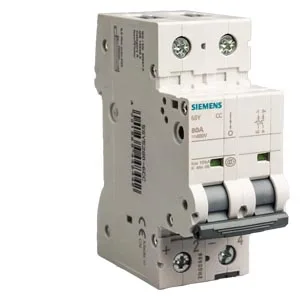
What this MCB is and what the ratings mean for fit
The Siemens 5SY5232-7KK11 is a 2-pole miniature circuit breaker from the SENTRON series, designed for universal current operation — it handles both AC and DC circuits, which is the key differentiator from a standard AC-only MCB. The C tripping characteristic (magnetic trip between 5 and 10 times In) makes it the typical choice for motor branch circuits, small transformers, and lighting banks where inrush currents are moderate. Rated 32 A at 35 °C ambient, it derates to 30.46 A at 40 °C and 27.14 A at 60 °C — so if your panel ambient runs warm, the effective continuous current is lower than the label. The 10 kA breaking capacity per EN 60898 (and 10 kA at DC per EN 60898-2) means it can safely interrupt a fault up to that level without welding contacts or cascading upstream; that's adequate for most secondary distribution panels fed by a transformer of 250 kVA or less. The 2-pole configuration (2P) switches both line and neutral simultaneously, which is required for single-phase circuits where the neutral is not solidly bonded, or for DC circuits where both poles need to open.
Deployment context and integration
Snaps onto DIN rail via the quick assembly system, occupying 2 modular width units (36 mm). Mounting position is unrestricted — any orientation works. The combined terminal design (top and bottom) accepts both busbar and conductor connections without separate accessories. Installation depth is 70 mm, overall depth 76 mm, height 90 mm. The IP20 rating applies with conductors connected, which is standard for enclosed distribution boards. Pollution degree 3 (conductive pollution or dry non-conductive that becomes conductive) means it's rated for industrial environments, not just clean office switchgear. The design is explicitly for railway applications, so vibration and temperature cycling are accounted for in the qualification.