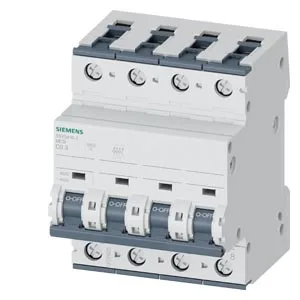
It breaks faults up to 10 kA per EN 60898 (AC) and 10 kA per EN 60898-2 (DC), which means it clears short-circuit currents up to that level without upstream coordination issues in a standard 400 VAC panel. The 4-pole (4P) configuration handles three-phase plus neutral protection in a single 72 mm wide housing — four modular width units that snap onto DIN rail.
The 0.3 A rating at 35 °C derates to 0.29 A at 40 °C and 0.25 A at 60 °C. That thermal curve governs real-world continuous current — if the panel ambient runs at 50 °C, the breaker carries 0.27 A before the bimetal trips. The C-curve (magnetic trip at 5–10× In) means it tolerates motor inrush and transformer magnetizing current without nuisance trips, but a 0.3 A C-curve is still a low-current device sized for control transformers, signal circuits, or small solenoid loads — not branch circuits. Polarity matters on DC — the supply cord position note says AC can land either way, but DC requires correct polarity. The universal current suitability (AC/DC) means the same breaker works on both, but the DC voltage rating is higher than typical 24 V or 48 V control buses, so it fits 400 VDC photovoltaic strings or 750 VDC traction battery circuits. Energy limitation class 3 means the let-through energy is low enough to protect downstream equipment in a coordinated distribution board. Pollution degree 2 (non-condensing, normal factory environment) and overvoltage category II (fixed-installation downstream of the main panel) define where it sits in the selectivity chain.
Width 72 mm (4 modular units at 18 mm each). Sealable, halogen-free, silicon-free — relevant for clean-room or food-bev lines where outgassing or tamper-proofing is a spec. Touch protection is built into the terminals, so no additional finger-safe shrouds needed for routine panel access.