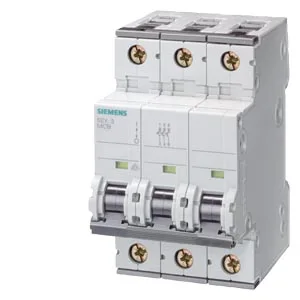
What this MCB is and where it lands
The Siemens SENTRON 5SY6301-8CC is a 3-pole miniature circuit breaker with a D tripping characteristic, rated 1 A at 400 V AC and a 6 kA breaking capacity per EN 60898. It occupies 3 modular width units (54 mm) on a DIN rail, mounts in any position, and is designed for mechanical engineering and industrial panel applications where high inrush currents — typical of motor starters, transformers, or discharge lighting — must not cause nuisance tripping.
D-curve and breaking capacity — what they mean for your panel
The D characteristic (10–20× In magnetic trip) means this 1 A breaker holds through the magnetizing inrush of a small control transformer or a 0.25 kW motor start without dropping out — that is the whole point of D-curve in a 1 A frame. The 6 kA breaking capacity at 400 V AC per EN 60898 certifies it can safely interrupt a fault current up to that level; under UL 1077 and CSA C22.2 No.235 it carries a 5 kA interrupting rating. Pollution degree 3 and overvoltage category III suit it for fixed industrial installations where transient overvoltages and conductive dust are expected.
Panel fit and environmental limits
Depth is 76 mm (installation depth 70 mm), width 54 mm (3 MW), height 90 mm. Fastens via the quick assembly system — snap-on to DIN rail, no tools needed. IP20 with connected conductors, so it belongs inside a closed panel, not in a washdown zone. Ambient range from -40 °C to 75 °C, with derating above 55 °C: max 95% RH at 55 °C, tapering to 35% RH at 75 °C. Halogen-free and silicon-free construction matters for sensitive environments like semiconductor fabs or clean rooms where outgassing contaminates processes.
Termination and supplementary devices
Combined terminals at top and bottom accept both copper busbar and conductor — no need to choose one or the other. The design accepts installable supplementary devices (auxiliary switches, shunt trips, alarm contacts) without removing the breaker from the rail. No neutral conductor switching on this 3-pole unit; it switches the three phases only. Power loss is 1 W per pole at rated current in hot operating state — negligible for thermal budgeting inside a crowded enclosure.