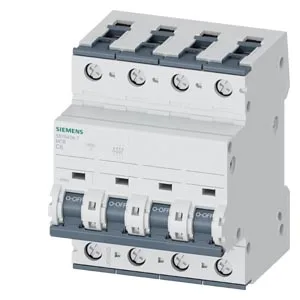
Its C-curve tripping characteristic (5–10× In) handles moderate inrush from motor starters and transformers without nuisance trips, while the 6 kA breaking capacity per EN 60898 covers standard domestic/commercial fault levels — but the real headroom is the 30 kA rating per IEC 60947-2, which lets it sit on higher-capacity industrial busways without needing a current-limiting fuse upstream. The dual standard means it's accepted under both wiring-rule (EN 60898) and industrial (IEC 60947-2) regimes; the UL 1077 listing at 5 kA opens North American supplementary-protection applications.
The 6 kA EN 60898 rating is the lower bound for residential/commercial schemes. On the DC side, it's rated 15 kA at 60–72 V, so it works in battery-backed DC distribution or solar combiner boxes.
IP20 with connected conductors — fine for a closed panel, not for washdown zones.
The temperature range (-40 to 75 °C) covers outdoor enclosures in cold climates and hot machinery cabinets; derate the continuous current per the thermal curve above 40 °C. Humidity tolerance is specified up to 95% at 55 °C, tapering to 35% at 75 °C — adequate for non-condensing industrial atmospheres. Standards compliance includes IEC/EN 60898-1, IEC/EN 60947-2, UL 1077, and CSA C22.2 No.235, which covers most global markets.