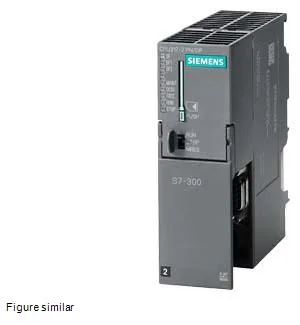
SIPLUS S7-300 CPU with extended temperature range
The 6AG1317-2EK14-7AB0 is a SIPLUS S7-300 CPU of type SFB (SIPLUS FB), supporting up to 8 function modules (FM 8). It is designed for environments where standard S7-300 CPUs cannot operate, with an ambient temperature range of -40 °C to 70 °C. This CPU integrates a PROFINET interface with IRT (isochronous real-time) capability, enabling deterministic communication for motion control and high-speed automation tasks. It also supports TCP/IP via the same interface and loadable function blocks. The compact form factor — 40 mm wide, 125 mm high, 130 mm deep — fits standard S7-300 racks, allowing direct replacement in existing panel layouts without re-drilling or re-wiring the backplane.
Programming and engineering toolchain
The CPU supports all IEC 61131-3 programming languages: LAD (ladder), FBD (function block diagram), SCL (structured text), STL (statement list), and GRAPH (sequential function chart). Additionally, it runs CFC (continuous function chart) and HiGraph® for state-graph-based programming. Engineering requires STEP 7 V5.5 or higher. The CPU also supports loadable function blocks for PROFINET communication as client or server.
I/O capacity and communication interfaces
Address space is 244 bytes each for inputs and outputs, with up to 32 overall modules (including 4 CP modules, 10 CP LAN, and 8 CP PtP). The CPU also has an integrated RS 485 interface. PROFIsafe is not supported on this CPU, so safety-oriented communication requires a separate fail-safe module or a different CPU variant. The I2t rating of 1 A²·s provides a guideline for fuse coordination on the backplane bus — useful when sizing the external 24 VDC supply protection.
Operational features and compliance
The CPU supports forcing of I/O, routing of communication, and retentive data storage (must be restarted at each restart). It is isolated and can operate as both PROFINET client and server. CE marked and ATEX certified, this CPU is suitable for installation in potentially explosive atmospheres (Zone 2/22) and harsh industrial environments where standard electronics would fail.