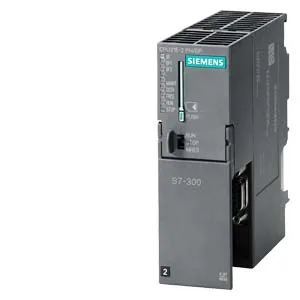
FM 8 — what it means for the build
The 6AG1315-2EH14-7AB0: The FM 8 designation on this CPU refers to the firmware and memory configuration — it defines the function block capacity and the operating system version, not the processing speed. If the existing program was built on an earlier FM version, the migration path is straightforward, but the firmware must match what the engineering station expects.
Programming languages — all of them
This CPU supports LAD, FBD, STL, SCL, GRAPH, HiGraph, and CFC — every IEC 61131-3 language plus Siemens' own high-level tools. That means a team mixing ladder for the safety circuit and SCL for the math blocks can all target the same processor without a translation layer.
Temperature range tells the story
Rated from -40 °C to 70 °C ambient, this is the SIPLUS variant — the same CPU logic as the standard 315-2 PN/DP, but with conformal coating and wider-tolerance components for unheated enclosures, cold stores, or outdoor cabinets. The standard version tops out at 60 °C; this one keeps running where the standard would flag a temperature fault.
ATEX and CE — compliance in one package
Carries ATEX certification for Zone 2 (gas) and Zone 22 (dust) areas, plus CE marking for EU machinery directive compliance. For a panel going into a potentially explosive atmosphere, this CPU saves having to segregate the controller into a purged enclosure — the certification is on the nameplate.
PROFINET with IRT — deterministic motion
Integrated PROFINET interface with IRT (isochronous real-time) support means this CPU can close a position loop over the network — think multi-axis gantries or synchronized conveyors where jitter matters. Also handles TCP/IP and UDP via the same port, so standard IT traffic coexists with the real-time channel.
Process image — 244 bytes each way
The CPU addresses 244 bytes of process input image and 244 bytes of process output image. That's the data exchanged each cycle with the I/O — not the physical I/O count. For a line-down spare, confirm the existing configuration fits within this image size; if the old CPU had a larger image, the program needs a recompile.
No PROFIsafe — this is standard safety, not failsafe
This CPU is type SFB (standard function block) and explicitly has no PROFIsafe capability. If the application needs a safety-rated controller that communicates over PROFIsafe to distributed safety I/O, this is the wrong CPU — you'd need a failsafe variant like the CPU 315F. For standard logic with a separate safety relay or safety PLC, this works fine.