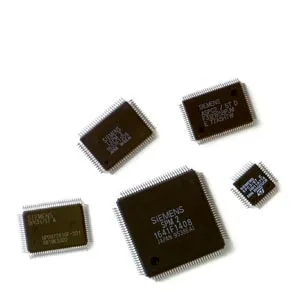
The Siemens 6ES7195-0BB20-0XA0 is the ASIC SPM 2, a dedicated slave controller for PROFIBUS DP that handles the entire bus access protocol inside the chip. No external microprocessor is required, and no firmware development is necessary for basic operation. It's rated for transmission rates up to 12 Mbit/s with automatic baud rate detection, and it's tailored for simple slave applications with up to 64 I/O bytes. Housed in a PQFP 120-pin package with an ASIC housing size of 10 cm², the chip draws a maximum power loss of 0.5 W.
Sourcing reality
The part is delivered in trays of 100 pieces per tray box. That packaging is factory-original; verify your pick-and-place feeder compatibility if you're ordering partial quantities, but we quote full-tray multiples by default.
Because bus access is handled internally, no external protocol chip or CPU is needed — just a 5 V supply and a standard PROFIBUS transceiver. The 0.5 W power loss is low enough that no heatsink is required in normal airflow. If your cabinet runs hotter than 55 °C at full I/O load, you'll need forced air or a derating assessment. The PQFP 120-pin footprint is standard, so PCB layout is straightforward with datasheet-landing pattern.
Why this part, not a PLC or I/O module
This is a chip-level component, not a finished module. It's intended for OEMs designing a PROFIBUS DP slave into their own hardware — drives, encoders, valve manifolds, or custom I/O boards. It replaces a microcontroller plus code with a single ASIC, saving development time and certification effort. The firmware scope is listed as 'not necessary', so once the hardware is laid out, the PROFIBUS stack is already inside the silicon.