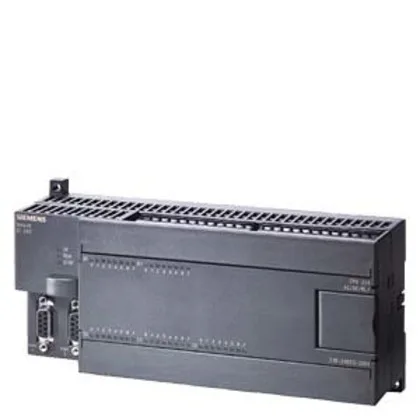
CPU 226 — the full-size S7-200 with MPI/PPI and 40 I/O
The Siemens 6ES7216-2AD23-0XB0 is a CPU 226 from the S7-200 family, packing 24 digital inputs and 16 relay outputs into a 196 x 80 x 62 mm housing. It runs on 24 V DC (permissible range 15.4 to 28.8 V) and draws a typical 11 W. The integrated RS 485 interface speaks both PPI and MPI protocols — PPI at 9.6/19.2/187.5 kbit/s for programming and HMI (TD 200, OP), and MPI as a slave for data exchange with S7-300/S7-400 CPUs, OPs, and push-button panels. That dual-protocol port means it folds into a mixed S7 line without a separate gateway module.
Programming and processing
The CPU supports LAD (ladder), FBD (function block diagram), and STL (statement list) — the full IEC 61131-3 trio, so you can work in whatever dialect the site standardises on. Program execution runs free-cycle (OB 1), interrupt-controlled, or time-controlled (1 to 255 ms). The command set covers bit logic, compare, timer, counter, clock, transmission, table, logic, shift/rotate, conversion, program control, interrupt/communications, logic stack, integer maths, floating-point, and numerical functions — enough for medium-complexity machine control without a function library add-on.
High-speed counting and pulse outputs
Six high-speed counters (30 kHz each, 32-bit including sign) are built in. They can be used as up/down counters or for connecting two incremental encoders with two pulse trains offset by 90° (max. 20 kHz for A/B counters). Parameterisable enable/reset inputs and interrupt facilities let you call a subroutine when a setpoint is reached or counting direction reverses. The pulse outputs (Q 0.0 and Q 0.1) switch from 0→1 in 2 µs and 1→0 in 10 µs, which is fast enough for basic stepper or servo pulse-train control without an external motion module.
Memory and backup
The entire program is stored maintenance-free on integral EEPROM. Current DB 1 values live in RAM; retentive memory bits, timers, and counters are buffered by a high-performance capacitor (min. 70 h at 40 °C, typ. 100 h). An optional battery module extends backup to 200 days. That capacitor-backed approach means no routine battery swaps on the production floor — the battery is only needed if the line sees extended power-downs.