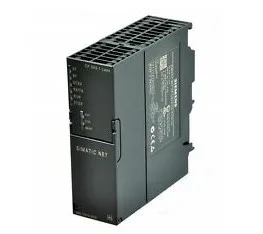
What this card actually is
The Siemens 6GK7343-1CX10-0XE0 is a Simatic S7-300 compact communications processor — single-width module format that snaps onto the S7-300 rail and draws its 5 V logic from the backplane bus while taking 24 V externally for the field-side electronics. On the network side it carries an integrated managed switch with four Industrial Ethernet ports presented as RJ45 jacks, running the first interface at 10/100 Mbit/s. It is a PROFINET IO device with ring-redundancy support, but without the IRT switch fabric you would need for isochronous motion. The card is configured with STEP 7 — either V5.4 or higher on the classic line, or STEP 7 Professional V11 (TIA Portal) or higher. It carries DCP, NTP, LLDP and TCP/IP services on board, plus SNMP v1 for diagnostics. Mechanical envelope is 40 mm wide by 125 mm tall by 120 mm deep, which fits the S7-300 single-width footprint and consumes one slot on the rail.
The headline is PROFINET IO device operation with a managed four-port switch — sized to act as a ring node on a PROFINET ring, not as a ring manager: that role has to live elsewhere on the segment. Power budget is 5.8 W typical dissipation off a 5 V backplane feed plus a 24 V external supply landed on a 2-pole pluggable terminal block. Plan the cabinet supply headroom accordingly — at 24 V the draw is modest, but the 5 V backplane budget is the tighter constraint on a loaded S7-300 rack. Security posture: IP-based ACLs are supported, but ACL-based filtering for PLC/routing scenarios is not. Services can be selectively switched off, the device supports I&M0 identification and MIB support, and SICLOCK time sync is on the menu — NTP is listed for plant-time alignment. Eight multicast stations can be registered and the module can act as a SIMATIC communication server. The card sits at IP20 — it is a panel-mount part, not a field enclosure. Storage and transport envelope runs −40 to +70 °C; handling that limit is what the wide span governs. Operating derating follows the usual S7-300 curve once the module is in service.
Integrator notes — what to watch when you wire it in
Configuration gate: the engineering workstation has to be on STEP 7 V5.4 or higher, or TIA Portal V11 (Professional) or higher. Older STEP 7 projects below V5.4 will not configure the module. The four RJ45 ports are a managed switch — segment them deliberately rather than daisy-chaining everything to one port. Multicast registration is capped at 8 stations, which is the practical ceiling on PROFINET multicast devices hanging off this CP. External 24 V lands on a 2-pole pluggable terminal block; keep the supply segregated from any noisy drive feeds and respect the IP20 cabinet rating during panel build.