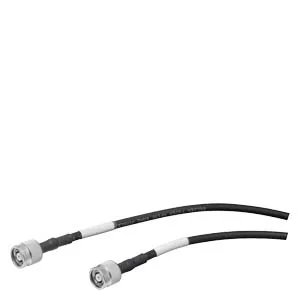
The Siemens 6GT2815-1BN10 is a pre-assembled coaxial cable for connecting a UHF antenna to an RF600 reader in an RFID installation. It is a fixed-length assembly, 10 m, with a characteristic impedance of 50 Ω — the standard for RF reader-to-antenna links in the 860–960 MHz UHF band. The cable is designated LMR-300, a low-loss 50 Ω coax with a solid copper inner conductor and a braided shield of tin-plated copper wires. Both ends terminate with R-TNC (female, straight) connectors. That connector type is common on Siemens RF600 readers and antennas — it mates directly without adapters.
The maximum voltage rating is 2000 V — that is the peak voltage the cable dielectric (PE) can withstand before breakdown, not the operating voltage. In practice, the RF signal on this cable is a few volts peak-to-peak; the 2000 V rating is a safety margin for transient or installation-phase faults. Attenuation at 900 MHz is 0.199 dB/m. Over the 10 m length that adds up to roughly 2 dB of signal loss — acceptable for typical reader-to-antenna distances in a warehouse or production line. If the run needs to be longer, a lower-loss cable (e.g., LMR-400) would be needed, but that changes the connector and impedance matching. The cable is flame-resistant per UL/NEC and CSA CMR/FT4 (only the cable without the plug). CMR (Communications Riser) and FT4 (Flame Test) ratings mean it can be run through vertical shafts and plenum spaces in commercial buildings without special conduit — a common requirement for RFID installations above drop ceilings or between floors.