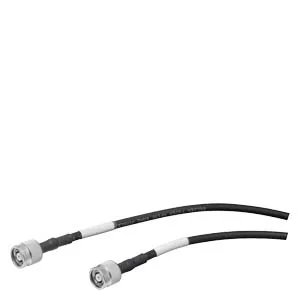
What this cable is and what it connects
The Siemens 6GT2815-2BN15 is a pre-assembled, highly flexible coaxial cable purpose-built for connecting a UHF antenna to an RF600 reader in an RFID installation. It's the factory-terminated drop for the SIMATIC RF600 antenna L15, with R-TNC (female, straight) connectors on both ends — no field termination required. Rated for a maximum of 1000 V and a characteristic impedance of 50 Ω, this cable is sized for the RF signal path, not power delivery. The 50 Ω impedance matches standard UHF antenna and reader ports, so signal reflections stay low across the 15 m run. At 900 MHz the cable exhibits 0.288 dB/m attenuation — about 4.3 dB total over the 15 m length. That's within the link budget for most RFID reader-to-antenna connections, but worth factoring in if the reader is marginal on output power or the antenna has low gain.
Deployment context — where this cable runs
The cable itself is trailing-rated, meaning it tolerates continuous flexing in cable carriers or drag chains, with a minimum bending radius of 100 mm under continuous bending and 22 mm for a single bend. The cable jacket is black PE (polyethylene), halogen-free is not specified, but it is silicon-free — important in paint-shop or coating environments where silicone outgassing causes adhesion failures. The braided shield is tin-plated copper wire, giving good EMI rejection in the UHF band around readers and industrial inverters. Rated for 100,000 bending cycles and 3,000,000 torsion cycles at ±180° on a 1 m length, this cable is built for robot cells or moving gantry applications where the antenna follows a moving target. The tensile load limit of 190 N means it can handle moderate pull forces during installation or cable-track operation, but don't use it as a structural support.
The 50 Ω impedance is the headline selection parameter — it must match both the reader's antenna port and the antenna's input impedance. If the reader or antenna expects 75 Ω or a different connector (N-type, SMA), this cable won't work without adapters that add loss. The R-TNC connectors are threaded, giving a vibration-resistant connection that won't shake loose on a moving gantry. The 1000 V maximum rating is the insulation withstand, not an operating voltage — the RF signal is low-voltage. It tells you the cable can share a cable tray with power cables without breakdown, as long as the tray fill and separation rules are followed. The flame-resistant jacket (UL style 1354 on the cable only, not the plug) means it passes vertical-tray flame tests for plenum or riser runs.