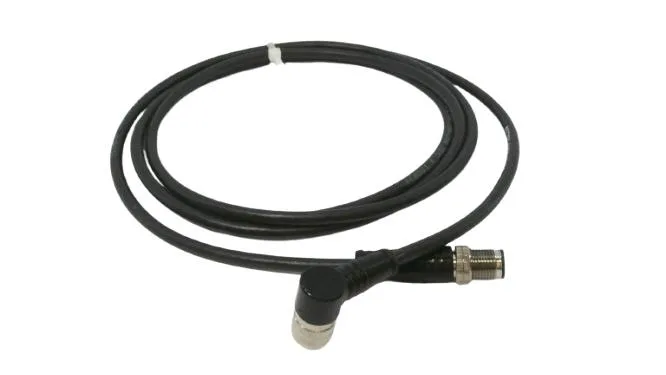
The Siemens 6GT2891-4JH20 is a pre-assembled SIMATIC RF MV plug-in cable, purpose-built to connect an RFID reader to a communication module like the ASM 456, RF160C, RF170C, or RF18XC. It's a 6-core, shielded, trailing cable with a braided shield of tin-plated copper wires, terminated with an M12 8-pin male straight connector on one end and an M12 8-pin female angled connector on the other. The 2 m length is a common drop for reader-to-module links in conveyor or portal installations where the module sits in a cabinet and the reader is on the line.
Rated at 300 V maximum, this cable handles the signal-level voltages typical of RFID systems — the reader and module operate at 24 VDC nominal, but the 300 V rating gives headroom for transient protection and meets UL's CM (Communications Cable) listing for plenum or riser runs when the cable is used without the plug. The 300 V rating is the cable's insulation rating, not the operating voltage of the RFID system. The cable is rated for continuous flexing with a minimum bend radius of 75 mm and a rated life of 3,000,000 bending cycles. That's a high-flex, trailing cable — designed for dynamic applications where the cable moves with a robot arm, a linear axis, or a sliding door on an RFID portal. The tensile load limit of 200 N means it can handle the pull forces of a cable carrier without failing the conductors or the shield. Temperature range is -30 to +80 °C across storage, transport, installation, and operation. That's a standard industrial range — fine for unheated warehouses, refrigerated areas, or near ovens as long as the ambient stays under 80 °C. The PVC insulation and sheath are rated flame-resistant per IEC 60332-1-2, so the cable passes vertical flame tests for fixed installations. The cable is resistant to grease, mineral oil, and UV radiation, and it's silicon-free. That makes it suitable for machine-tool environments where cutting oils and coolants are present, and for outdoor or sun-exposed runs. It is not halogen-free, so in a fire it will produce halogenated gases — not a choice for plenum spaces in Europe where low-smoke zero-halogen is mandated. Loop resistance is a maximum of 160 mΩ/m, and insulation resistance is 20 GΩ·m. For a 2 m cable, the loop resistance is under 0.32 Ω — negligible for the signal levels in an RFID system. The insulation resistance is high enough that leakage over the cable length won't affect the RS-485 or similar differential signals these cables typically carry.
Deployment context
This cable is the link between an RFID reader mounted on a conveyor or portal and the communication module inside the control cabinet. The M12 connectors are industry-standard for sensors and RFID heads — the male straight end plugs into the reader, the female angled end connects to the module. The angled connector saves space in tight cabinet layouts or where the cable exits the module parallel to the mounting surface. The trailing cable construction and high flex life suit it for applications where the reader moves — on a gantry, a robot end-effector, or a sliding door.