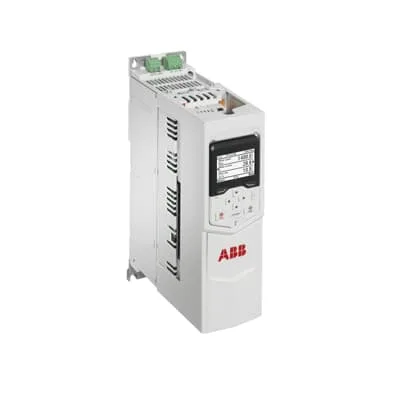
It delivers 0.75 kW (4.8 A) under normal use on a 200...240 V three-phase supply, with a heavy-duty rating of 0.55 kW (4 A) and a light-overload rating of 0.75 kW (4.5 A). The UL listing shows 0.75 Hp heavy-duty and 1 Hp light-overload at 4.5 A. Frame size is R1, enclosure IP20, and the module includes a PC connection port.
The three current ratings — 4.8 A normal-use, 4.5 A light-overload, and 4 A heavy-duty — correspond to different application profiles. Normal-use (Pn) is for constant-torque loads at rated speed; light-overload (PlD) allows brief overloads typical of pumps and fans; heavy-duty (PhD) is for high-starting-torque or cyclic loads like conveyors or crushers. The 0.98 power factor and IE2 efficiency level are consistent with a modern PWM drive.
Rated for ambient temperatures up to 40 °C and humidity 5...95 % non-condensing. Altitude limit is 1000 m without derating. Standby loss is 29 W, which contributes to cabinet heat load. Sound level is 47 dB(A) — quiet enough for a control room.
The module carries 2 analog inputs, 2 analog outputs, and 6 digital inputs / 5 digital outputs. Communication is via CAN; there is no onboard industrial Ethernet interface (0 hardware interfaces for Ethernet). The digital I/O count is enough for basic start/stop, fault reset, and speed reference, but for fieldbus integration you will need an external gateway or option module. The battery-backed real-time clock uses two CR2032 lithium coin cells (220 mAh, 3 V) — keep spares on hand; they are standard.