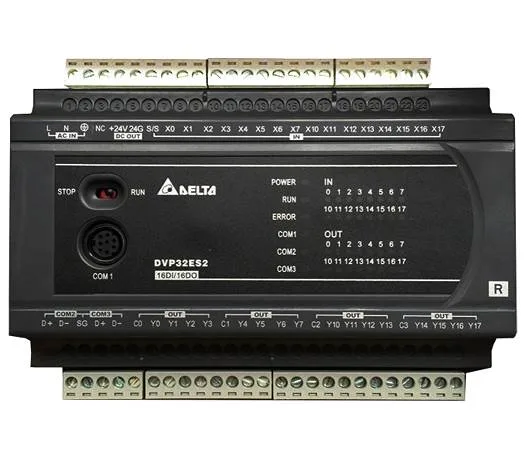
What this PLC brings to a control panel
The Delta DVP60ES200R is a 60-I/O programmable logic controller from the DVP Series, built for medium-scale discrete and process control. It carries 36 inputs and 24 relay outputs, powered from a universal 100-240 VAC supply. The relay outputs handle up to 2 A per point typically, switching motor starters, contactors, solenoids, and indicator loads directly without external interposing relays — a common need on a pulp-and-paper wet-end or finishing line where you want to keep the cabinet simple and the machine running. The 36-input count suits applications like a multi-stage conveyor system, a batch reactor with discrete level and valve feedback, or a paper-machine section with dozens of proximity and limit switches. The 24 relay outputs give you the current-carrying capacity to drive the loads directly, which saves panel space and wiring time compared to adding interface relays for every output.
Relay vs. transistor output — the real decision
The DVP60ES200R uses relay outputs, while its sibling DVP60ES200T uses transistor (sink/source) outputs. The relay version is the right call when you need to switch mixed AC/DC loads, high inrush currents, or voltages above 24 VDC — typical for driving motor contactors, hydraulic valve coils, or heater contactors in a mill environment. The transistor version is faster (no mechanical wear, higher switching frequency) but limited to 24 VDC low-current loads. If your application is all 24 VDC sensors and small solenoid valves, the DVP60ES200T may be a better fit; if you have any 120 VAC or 24 VDC loads above 0.5 A, the relay version is the practical choice.
The DVP60ES200R mounts on a DIN rail in the control cabinet. The 60-I/O density fits a medium-sized panel; plan for at least 300 mm of DIN rail width plus clearance for wiring ducts. The relay outputs use common terminals — wire the commons per load group (same phase/voltage) to keep the wiring tidy. Inputs are typically 24 VDC sink/source; verify your sensor type before terminating.