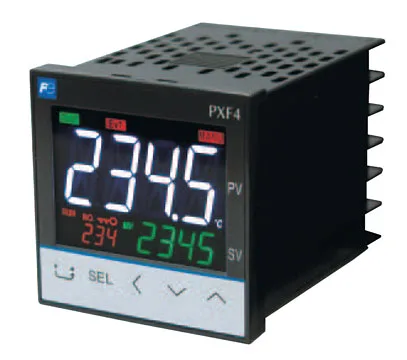
That 48x48mm front panel is the standard cutout for a single-loop controller — drops into any panel already punched for that footprint, no adapter plate needed. The 50ms sampling speed means it reads the input and updates the output every 50 milliseconds. For a plastic extruder barrel zone or a reflow oven ramp, that's fast enough to catch a thermal overshoot before it drifts past the process limit. Slower controllers (250ms or 500ms) let the temperature walk between samples; this one doesn't. Self-tuning is the feature that saves the commissioning engineer a PID loop-tuning session. Power it up, set the setpoint, and the controller runs through an autotune cycle — it learns the process gain, the time constant, and the dead time, then sets its own P, I, and D terms. Works well on thermal loops with consistent load profiles; skip it on highly variable processes and tune manually. The control output is a single SPDT relay contact. That's a dry contact rated for switching the coil of a contactor or a solid-state relay driver — not for direct heater current above a few amps. If you're driving a 15A resistive heater, buffer it through an SSR. The relay gives you isolation and a simple on/off or time-proportional output.
Alarm outputs and power supply
Two alarm output points are available. Typical use: one configured as a high-temperature alarm (process over-limit), the second as a low-temperature alarm or a heater-break alarm. Each alarm can be assigned to a separate relay or logic output, depending on the output configuration ordered. The power supply accepts 100-240V AC, 50/60Hz — universal for any plant floor voltage in North America, Europe, or Asia. No need to order a separate transformer or a 24V DC version; it runs straight off the control panel's line voltage. Programming uses North American Code — the parameter set and display conventions follow the standard for the US market. If your plant runs Fuji's standard global firmware, the parameter map differs; this variant matches the North American documentation set.