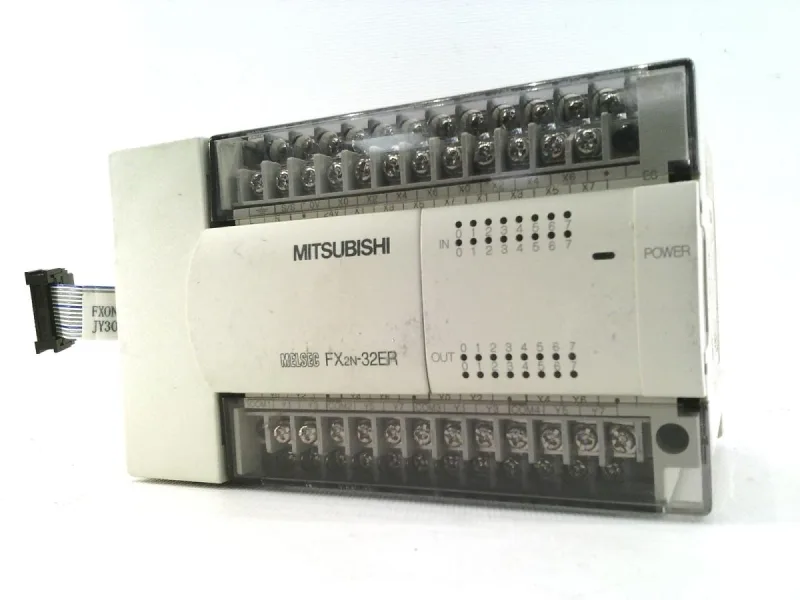
The Mitsubishi FX2N-32ER-ES/UL is a compact brick PLC in the FX2N family — a base unit carrying 16 inputs and 16 relay outputs on removable M3 screw terminal blocks, with the CPU, supply and I/O all in one housing rather than a rack or backplane design. It runs on AC 100–240 V at 50/60 Hz, tolerates 85–264 V on the mains, and draws 30 W — internal supply is fused at 250 V 3.15 A — so a single cabinet feed covers the unit without an external 24 VDC PSU for the CPU. Programming sits on the FX1N / FX2N / FX3G / FX3U application sequencer toolchain, which means existing project files and ladder libraries carry across the family without a translator step. Built to slot into a standard industrial cabinet: 0 to 55 °C operating, 5–95 % RH non-condensing, vibration and shock qualified per IEC 61131-2, and rated for use only below 2000 m altitude.
Inputs and outputs — what they actually switch
Inputs are sink/source compatible, accept no-voltage contact or NPN/PNP open-collector drivers at 24 VDC ±10 %, draw about 5 mA per point at 24 VDC through a 4.3 kΩ input impedance, and are photocoupler-isolated from the logic — so a 3-wire PNP prox or a 2-wire contact drops on without a polarity jumper. Minimum load is DC 5 V 2 mA, which is the reference figure for keeping a high-impedance input stage in the ON state; below that the input may not register reliably. Relay outputs are rated 80 VA inductive per point, with external switching envelope up to 240 VAC / 30 VDC (250 VAC where CE/UL/cUL does not apply), which covers solenoid valves, contactors and small motor contactor coils but not large motor starters directly. Both input ON→OFF and OFF→ON response are about 10 ms, set by the input filter and the relay mechanical time — fast enough for limit switches and proximity sensors, slow enough that high-speed counting belongs on a dedicated high-speed input module. Insulation is mechanical on the output relays and photocoupler on the inputs; the supply-to-earth withstand is 1500 VAC for 1 minute and the I/O-to-earth 500 VAC for 1 minute, with insulation resistance ≥500 MΩ at 500 VDC. Mains inrush peaks at 40 A at 100 V or 60 A at 200 V for ≤5 ms — a standard Type B or C breaker on the cabinet feed handles it, but the supply fuse inside the unit is 250 V 3.15 A.
Electrical environment and noise
Grounding requires Class D grounding at 100 Ω or less, dedicated or common ground — the unit must share a low-impedance earth return with the rest of the panel for the noise and isolation figures to hold. Ambient atmosphere must be free of corrosive gas, flammable gas and conductive dust, consistent with general-purpose industrial cabinets; sealed or purged enclosure is needed for harsh process areas.
Lifecycle — what EOL/hot means for sourcing
For a running line, that means the move is to lock in a multi-year spare allocation through a stocking partner now; for a new design, the equivalent going-forward base unit in the FX family is the natural platform to specify rather than committing new production to an EOL base.