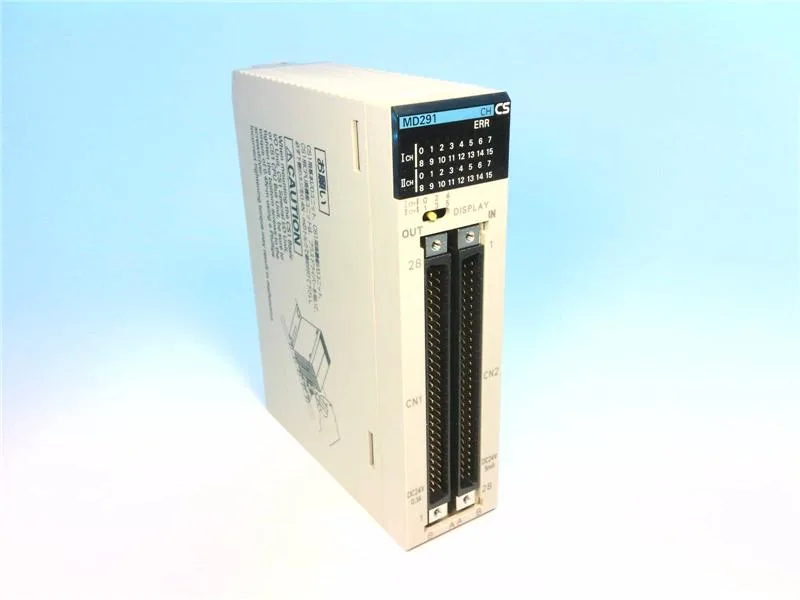
What it sits as on the rack
The Omron CS1W-MD291 is a mixed digital I/O module for the CS Series family — a single backplane card carrying 48 digital inputs and 48 solid-state outputs on the same connector footprint, so one slot services both signal directions into the controller. It's a backplane-mounted module with rectangular-connector field wiring, shipped in bulk packaging, and carries the full agency set the CS Series tends to land with: CE, CSA, Lloyd, NK, and UL on the approval roster.
Where this class earns its slot
A 48-in / 48-out mixed card is the right density choice when a CS rack has more digital I/O than dedicated input or output slots want to absorb — it lets the integrator collapse a slot pair into one, leaving rack room for specialty cards (high-speed counters, analog, comms) that can't be subbed with a pure digital module. Field wiring lands on the rectangular connector at the card face; the same connector pattern is used across the CS1W I/O range, so termination practice established for adjacent CS cards carries over without re-tooling.
Sizing against the CS1W siblings
Within the CS1W family the CS1W-MD291 is the largest balanced mixed module; the closest same-class alternative, the CS1W-MD261, drops to 32 digital inputs and 32 solid-state outputs on the same backplane format — useful as a density half-step when a 48/48 card over-specs the I/O count but you want to stay in the mixed-I/O flavour. For pure-direction panels, the higher-density options are the CS1W-OD291 at 96 solid-state outputs and the CS1W-ID261 at 64 digital inputs — both backplane modules in the same CS1W shell, and both the cards you'd specify instead of an MD variant when every point runs one way.
Lifecycle posture
That said, the channel-side lifecycle flag on this card reads eol_hot, which means it's being watched for end-of-life pressure even while still orderable — a planning buyer should treat it as a part to specify on a near-term BOM rather than park on a multi-year spares shelf without a re-quote.