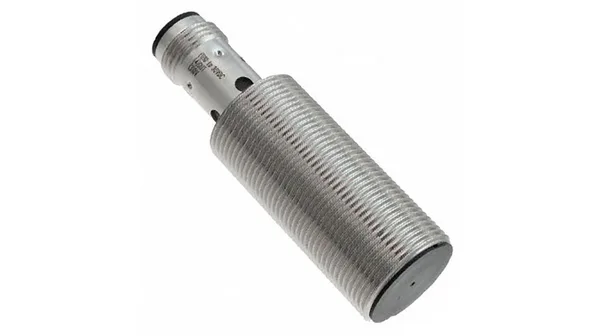
8 mm flush-mount — what the correction factors mean for your target
The E2BM18KS08M1B1OMI: The 8 mm sensing distance is rated on mild steel. For stainless steel, the correction factor is roughly 0.7×, so budget 5–6 mm in a stainless target application — if the gap between sensor face and target is tight, the sensor may not detect reliably. Flush mount means the sensor face can be embedded in a metal bracket without derating the sensing range — non-flush sensors lose range when mounted flush. That makes this M18 barrel a direct drop-in for existing M18 flush-mount holes.
PNP NO output — direct PLC interface without extra components
PNP normally-open output sourcing up to 200 mA at 10–30 VDC. That means the sensor switches the positive side — common for most PLC digital inputs — so no pull-up resistor or level shifter is needed between the sensor and the input card. Current consumption is 10 mA, leaving 190 mA of the 200 mA budget for the load — adequate for a single PLC input or a small relay coil.
IP67 brass housing — washdown-ready for wet or corrosive lines
IP67 rating means the sensor body and the M12 connector interface are protected against temporary immersion — suitable for washdown environments in food processing, packaging, or machining coolant splash. Brass nickel-plated housing resists corrosion better than unplated steel — the nickel layer holds up in mildly acidic or alkaline wash solutions, though stainless variants (like the E2BS08KS02MCB120OMS) are preferred for aggressive chemical exposure.
Switching frequency — 500 Hz is fine for discrete parts, tight for high-speed
500 Hz switching frequency means the sensor can detect an object passing every 2 ms. For a conveyor moving at 1 m/s, that resolves parts spaced about 2 mm apart — adequate for most discrete part detection, but a high-speed pick-and-place or a rotating shaft with small teeth may need a 1.5 kHz sensor.
Active production — no lifecycle risk for new builds
No stock-holding claim — sourced per RFQ from authorized Omron distribution.