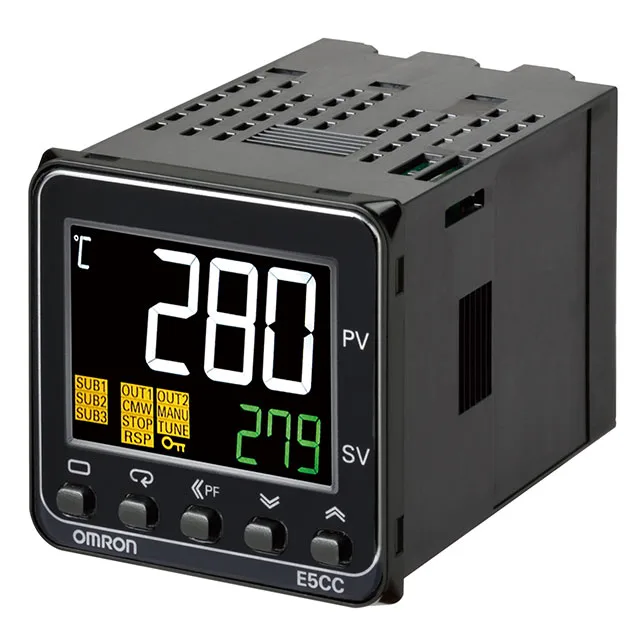
Sensor input flexibility and what it means for your loop
The E5CC-TCQ3D5M-001 accepts RTD and 13 thermocouple types (B, E, J, K, L, N, PLII, R, S, T, U, W) plus linear analog signals 0-20 mA or 0-10 VDC. That covers virtually every common process sensor — you can standardise one controller across multiple loop types without stocking different models. Input range spans -200°C to 2300°C for thermocouples, so it handles both cryogenic and high-temperature kiln/oven applications. The 0-20 mA and 0-10 VDC ranges let it accept pressure, flow, or level transmitter signals as well.
Output architecture — three relays plus analog and SSR drive
Three relay outputs handle on/off control, alarm annunciation, or valve positioning. The analog output (likely 4-20 mA or 0-10 VDC) provides a retransmitted process value or drives a proportional valve/actuator. The voltage pulse output fires an external SSR for fast-cycling heater loads — this combination means you don't need a separate signal conditioner or output expander for most single-loop applications. Control method is selectable between On/Off and proportional (PID). The PID algorithm includes auto-tuning, so commissioning is straightforward: wire the sensor and output, initiate the tune cycle, and the controller sets its own P, I, and D terms.
Screw terminal connections simplify field wiring. IP66 front-panel rating means the display and keypad survive hose-down cleaning and dusty environments. The operating range is -10°C to 55°C, adequate for most indoor control panels but not for direct outdoor exposure without a weatherproof enclosure.
Heater fault detection and event input
Heater fault detection monitors the load current via an external CT and flags a broken heater or SSR short-circuit — critical for electric heaters where an undetected failure can cause process drift or safety issues. The event input allows remote switching between two setpoints or starting/stopping the control action, useful for interlocking with a safety circuit or a higher-level PLC.