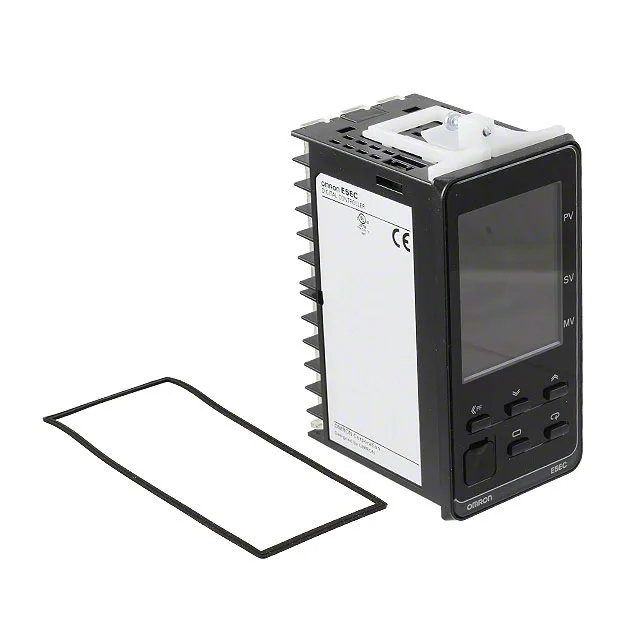
What this controller brings to the panel
The Omron E5EC-TQQ4A5M-010 is a process and temperature controller from the E5EC-T series, built to handle both RTD and thermocouple inputs — type B, E, J, K, L, N, PLII, R, S, T, U, W — plus 0–20 mA or 0–10 VDC linear signals. That input range spans -200°C to 2300°C, so it covers cryogenic monitoring right up to high-temp furnace loops without swapping modules. Outputs are split: four relay outputs for on/off or alarm duties, plus two voltage-pulsed outputs for driving external SSRs. That SSR pair is what makes this controller a good fit for a heater zone where you want zero mechanical wear on the switching element — the relays handle the event flags and the voltage outputs fire the power stage. The control method gives you a choice between simple on/off and full proportional (PID) with auto-tune. For a process that needs to hold a setpoint without overshoot — say a plastic extruder barrel or a heat-treat oven — the PID loop is what you commission first. The on/off mode is there for level alarms or simple batch heaters where a deadband is acceptable.
Panel fit and environmental sealing
Mounts in a rectangular panel cutout 92.00 mm x 45.00 mm and secures with screw terminals. The front face carries an IP66 rating. If the panel sees direct radiant heat from a kiln or a dryer, keep the controller below that upper bound — the spec is for ambient at the controller, not the process temperature.
Built-in diagnostics: heater fault detection and event input
Heater fault detection is included — it monitors current draw on the load side and flags a broken heater or a failed SSR. That's a practical line-down saver: instead of waiting for the process temperature to drift, the controller tells you the heating circuit has failed on the next cycle. The event input lets an external contact (a limit switch, a safety interlock, a remote start signal) change the controller's behavior — switch between two setpoints, hold the output, or trigger a ramp-soak profile. That keeps the logic in the controller rather than forcing a PLC to handle every mode change.