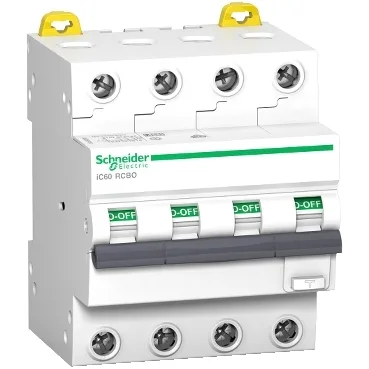
That means one device handles both the overcurrent and ground-fault duties for a three-phase outgoer, saving a module width in the distribution board.
Rated breaking capacity is 6 kA Icn at 380–415 V AC, 50 Hz, conforming to EN/IEC 61009-2-1, with an Icu of 6 kA per EN/IEC 60947-2. That is the standard residential and light-commercial fault level in most European 400 V three-phase networks — adequate for a distribution board fed by a transformer of typical impedance. The limitation class is 1 per EN/IEC 61009-2-1, meaning it lets through the full prospective current for the first half-cycle before limiting.
The 4-pole body takes 8 pitches of 9 mm — 72 mm wide, 86 mm tall, 78 mm deep. Tunnel-type terminals accept 1 to 35 mm² rigid or 1 to 25 mm² flexible; strip 12 mm and torque to 2 N·m. IP40 in a distribution enclosure, IP20 on the terminals. The toggle gives local indication of ON, OFF, and fault trip states — useful for a panel builder or service tech tracing a tripped outgoer without a meter.