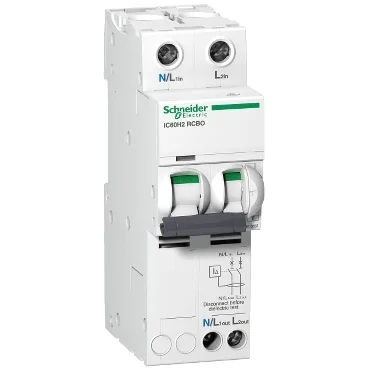
The 20 A rated current at 50 °C is the continuous load the thermal-magnetic trip can carry without nuisance tripping in a warm enclosure. The C-curve (magnetic trip at 5–10× In) is standard for inductive loads like contactor coils, small motors, and fluorescent lighting — it rides out inrush without opening, unlike a B-curve that would trip on a motor start. The 300 mA earth-leakage sensitivity is a general-purpose protection level for circuits where 30 mA would cause unwanted tripping due to cable capacitance or equipment leakage; it is not intended for personnel protection (that requires ≤30 mA).
Screw-clamp terminals accept 1–25 mm² rigid on top, 1–16 mm² flexible on bottom; torque to 3.5 N·m top, 2 N·m bottom. Strip length is 13 mm bottom, 14 mm top. The toggle provides ON/OFF indication, and the contact position indicator confirms the state visually — useful for isolation verification during commissioning or maintenance. IP20 finger-safe terminals only; this is for enclosure-internal mounting, not outdoor or washdown exposure.
Certified to AS/NZS 61009.1, IEC 61009-1, and IEC 61009-2-2 — the harmonized RCBO standards covering overcurrent and residual-current protection. The part is suitable for isolation (disconnect function verified) and can be padlocked with a 4 mm Ø padlock for lockout/tagout. Tropicalisation class 2 means the device is tested for damp-heat conditions (95 % RH at 55 °C). Mechanical durability is rated at 20,000 cycles, electrical at 5,000 cycles — these are the expected operational life under rated load. For validation documentation (declarations of conformity, material certificates), these are typically available through Schneider's product documentation portal under the Acti9 iC60 range.