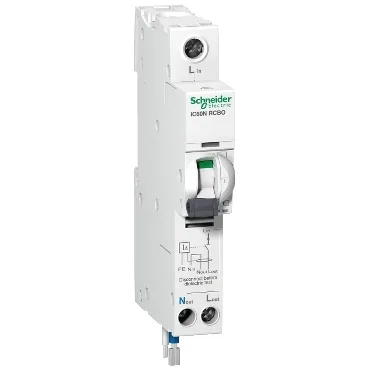
It combines a C-curve MCB and a 30 mA earth-leakage detector in one DIN-rail unit, saving a module over separate devices. The 32 A rated current at 50 °C is the continuous load it can carry in a 50 °C ambient; above that temperature, the thermal-magnetic trip element derates per the IEC 61009-1 curve. The C-curve means the magnetic trip fires at 5 to 10 times In — 160 to 320 A — so it handles motor inrush and lighting ballast starts without nuisance tripping, but clears a hard short fast enough for 6 kA Icn at 230/240 V AC. The 30 mA earth-leakage sensitivity provides personal protection against direct contact; it's the standard threshold for socket-outlet and general-purpose final circuits under IEC 60364. The 1P + Ns pole configuration switches the phase and monitors the neutral, with the neutral on the left — important for panel layout consistency when bussing.
Height is 110 mm, depth 77.5 mm — that depth includes the toggle and terminal screws, so verify clearance to the enclosure door or gland plate. Screw-clamp terminals accept 1 to 25 mm² rigid (top) and 1 to 16 mm² flexible (top), with a tightening torque of 3.5 N.m on the top and 2 N.m on the bottom.
The A9D61832 is certified to IEC 61009-1, AS/NZS 61009.1, and IEC 61009-2-2. IEC 61009-1 is the international standard for RCBOs — it covers the combined overcurrent and residual-current protection, including the trip coordination and endurance tests. AS/NZS 61009.1 is the Australian/New Zealand adoption. IEC 61009-2-2 covers the EMC immunity requirements for the electronic residual-current detection circuit. The part carries the CE marking and is designed for TN earthing systems. Compliance documentation (declaration of conformity, CE certificate) is available from the manufacturer's document portal under the Acti9 iC60N series.