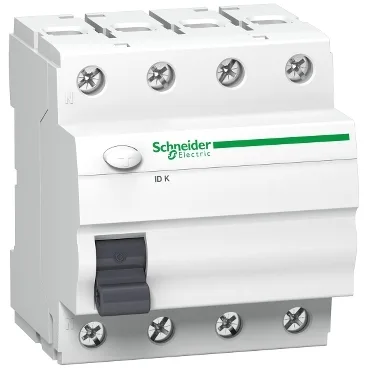
The Schneider Electric A9KR16463 is a 4-pole residual current circuit breaker (RCCB) from the Acti9 ID K family, rated 63 A with 300 mA earth-leakage sensitivity, Type AC, and instantaneous tripping.
The 63 A rated current (In) and 300 mA sensitivity mean this RCCB protects a sub-feed or group of circuits against earth faults, not individual branch overloads — it has no overcurrent protection built in. Voltage-independent tripping means it clears a fault even if the line voltage collapses, which is standard for electromechanical RCCBs and a reliability point for group incomer duty. Breaking capacity is rated Idm 630 A / Im 630 A — this is the RCCB's short-circuit making and breaking capacity, not a high-fault interrupting rating. It relies on an upstream MCB or fuse to clear a bolted fault; the RCCB itself handles the residual current interruption within its capability. Rated operational voltage is 380...415 V AC 50 Hz, insulation voltage 440 V AC. This covers standard three-phase 400 V networks across Europe and markets following IEC 61008-1.
Terminals accept up to 35 mm² rigid or 25 mm² flexible (biconnect top and bottom), with a stripping length of 14 mm and tightening torque of 3.5 N.m. The 72 mm width fits standard modular enclosure spacing — plan for 8 module pitches in your DIN rail layout. IP20 on the body, IP40 inside the modular enclosure.
For BOM freeze or PCN watch, the relevant standard is EN/IEC 61008-1 (RCCB general rules).
Where it sits in the system
Schneider designates this as a group incomer — the RCCB at the head of a sub-distribution board or feeding a group of final circuits. It protects against earth faults downstream; each outgoing circuit needs its own overcurrent protective device (MCB or fuse).