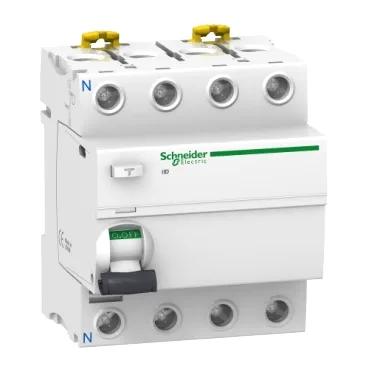
The A9R04491: The 100 A [In] rated current means this RCCB handles the full load of a main distribution board or heavy sub-main feeder — not a branch circuit. The 300 mA sensitivity is a deliberate choice: it's above the 30 mA required for personal shock protection, so this device is used for fire protection or equipment protection on circuits where nuisance tripping from normal leakage (long cable runs, heaters, VFDs) would be a problem. Type A detection catches pulsating DC residual currents from rectifiers and electronics, which a plain AC-only RCCB would miss. Rated operational voltage is 380...415 V AC 50/60 Hz, which covers standard three-phase European and UK supplies (400/415 V). Breaking capacity is 1500 A (Idm / Im) — adequate for a downstream RCCB in a domestic or light commercial panel where the upstream MCB or fuse limits fault current, but not for high-fault industrial boards where SCCR above 10 kA is common. The voltage-independent tripping mechanism means the RCCB detects leakage and trips even if the phase voltage is lost — a safety advantage over electronic RCDs that need a power supply. The instantaneous time delay (no intentional delay) means it trips within 40 ms on a fault, which is the standard for basic shock protection in residential and commercial installations per EN/IEC 61008-1.
This is an outgoer device — it sits downstream of the main switch or incoming circuit breaker, feeding sub-circuits. The clip-on DIN rail mount and 72 mm width (8 pitches) mean it slots into a standard modular enclosure alongside MCBs and other RCCBs. Neutral is on the left, so plan busbar orientation accordingly. The IP20 body is fine for a closed panel; IP40 with the modular enclosure covers the live terminals. Terminals accept up to 35 mm² rigid or 25 mm² flexible cable, which is appropriate for the 100 A rating — expect to land 25–35 mm² tails. A padlocking device can be fitted for lockout/tagout during maintenance.