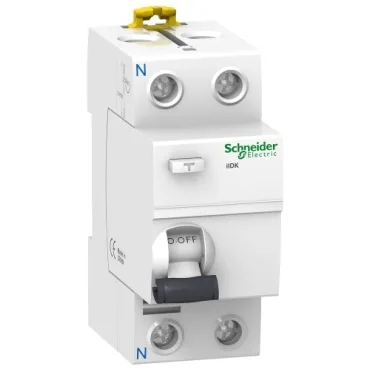
It protects against earth faults by detecting leakage current and disconnecting the circuit. Rated at 40 A with 30 mA earth-leakage sensitivity, Type AC (responsive to sinusoidal AC residual currents).
The 30 mA sensitivity is the standard threshold for personal shock protection in residential and commercial final circuits — it trips before leakage current reaches a level that could cause ventricular fibrillation. Type AC means it detects pure sinusoidal AC faults only; for pulsed DC or mixed-frequency faults, a Type A or Type B RCCB would be needed. Rated conditional short-circuit current Inc is 4500 A — this is the fault current the device can withstand when backed by an upstream overcurrent protective device (typically a MCB or fuse). The 4 kV impulse withstand voltage (Uimp) covers typical mains transient events in a TN or TT system. Rated insulation voltage Ui is 440 V AC, so the RCCB is suitable for 230/400 V three-phase systems when used on a line-to-neutral derived single-phase circuit. Voltage-independent tripping technology means the RCCB does not require an external power source to operate — it uses the fault current itself to energize the trip mechanism, which improves reliability during neutral loss conditions.
Occupies two pole positions in a modular enclosure. Neutral on the left side per the device layout. Tightening torque 3.5 N.m. Wire strip length 16 mm for top or bottom connection. IP20 rated (finger-safe), IP40 in modular enclosure. No contact position indicator — visual check of the toggle is the only status feedback. Padlocking provision available for lockout/tagout.
NF quality label indicates French national certification. Pollution degree 2 (non-conductive pollution only, occasional condensation). Electromagnetic compatibility verified: 8/20 µs impulse withstand at 200 A per EN/IEC 61008-1, ensuring the device does not nuisance-trip on common surge events.