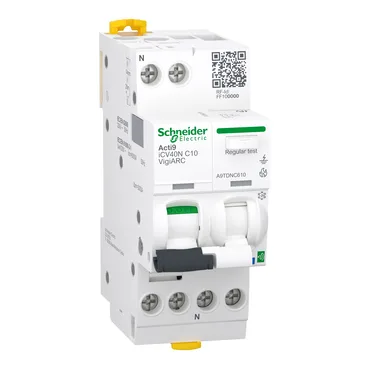
It combines earth leakage and overload/arc-fault detection in a single 36 mm wide module that clips onto a DIN rail. The arc-fault detection (the 'ARC' in the name) is the main differentiator here. It monitors the waveform for the high-frequency signature of a series or parallel arc — loose connection, damaged cable, carbonised insulation — and trips before the fault escalates. That's a layer of protection a standard RCBO or MCB alone doesn't cover.
Breaking capacity of 6000 A Icn at 230 V AC meets the EN/IEC 61009-2-1 standard for RCBOs. The thermal-magnetic trip unit gives the C-curve response: magnetic trip between 5 and 10 times In (50–100 A for this 10 A unit), thermal overload following the inverse-time characteristic. Accuracy specs on the metering side: voltage ±2 %, current ±2 %, power ±5 %. That's not revenue-grade, but it's good enough for energy monitoring and fault logging — you'll see a 2 % drift on a 230 V reading before the protection elements act. Mechanical durability matches at 20000 cycles. For a panel that sees daily switching, that's roughly a 10-year service life at 5 operations per day.
Clip-on mounting to a DIN rail, 36 mm width (2 module pitches at 18 mm each, though the evidence lists 4 pitches of 9 mm). Height 91 mm, depth 73 mm — fits standard distribution board cutouts. Neutral on the left, cable entry from top and bottom. The spring-cage or screw terminal (toggle control) accepts solid or stranded copper up to the rated cross-section. Pollution degree 2 — suitable for normal industrial or commercial environments where only non-conductive pollution occurs, with occasional condensation. Tropicalisation severity B per IEC 60068-2-30 for 28 days — the device is tested for damp-heat cyclic exposure.
Compliance documentation: the device carries approvals to EN/IEC 62606 (arc-fault detection device standard), EN/IEC 61009-1, and EN/IEC 61009-2-1 (RCBO standards). Targeted country is India, but the standards are international.