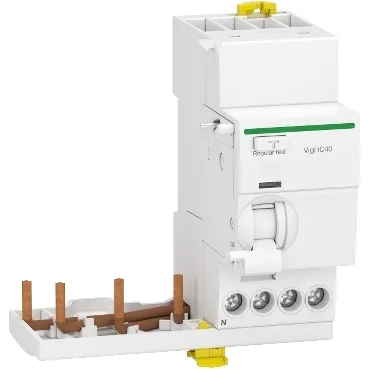
The unit handles 400 V AC at 50/60 Hz and carries a 4 kV impulse withstand rating per EN/IEC 61009-2-1. That standard covers both the RCD and the MCB it mates with, so the whole assembly is coordination-tested.
The 40 A rating tells you this RCD can sit on a 40 A feeder outgoer, protecting a circuit that draws up to that load. The 300 mA sensitivity is a common choice for general-purpose socket-outlet protection in commercial or industrial panels — it's less prone to nuisance tripping than a 30 mA unit on longer cable runs with natural leakage. The instantaneous trip means no intentional time delay — it clears the fault as fast as the internal solenoid can move. The voltage-independent trip mechanism is a practical advantage: even if the neutral is lost or the supply voltage collapses, the RCD still detects a ground fault and opens. That's important in older installations or temporary power setups where the neutral path might not be reliable. It'll survive the storage extremes of -40 to 85 °C just fine.
This is a clip-on add-on module that mounts to the right side of a compatible Acti9 MCB on a DIN rail. The bottom tunnel terminals accept 1 to 16 mm² rigid or 1 to 10 mm² flexible, with a 14 mm strip length and 2 N.m tightening torque. The screw connection to the MCB passes both phase and neutral through the RCD's sensing coil. The IP20 rating on the body means finger-safe, but the modular enclosure inside the panel achieves IP40. For a panel environment, that's standard — just don't mount it exposed to washdown or direct spray without a higher-rated enclosure.