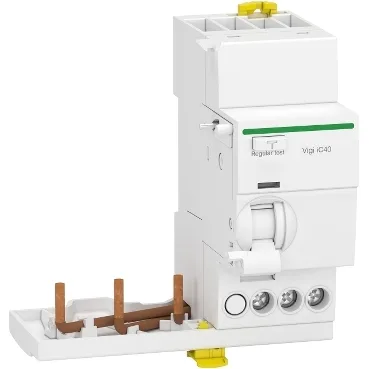
It is a 3-pole unit rated 25 A with 300 mA earth-leakage sensitivity, Type A protection, and instantaneous tripping — voltage independent, so it operates even if the neutral is lost. Rated operational voltage is 400 V AC at 50/60 Hz, with insulation rated 440 V and impulse withstand at 4 kV per EN/IEC 61009-2-1. Pollution degree 3, so it handles industrial environments without conformal coating concerns. Mounts via clip-on to DIN rail — 4 module pitches (9 mm each) wide at 90 mm. Depth is 74 mm, height 99.5 mm. IP20 on the body, IP40 inside the modular enclosure.
The 300 mA sensitivity is for equipment protection, not personnel shock — that threshold is above the 30 mA required for direct-contact protection. Use this where the priority is fire prevention or equipment damage from leakage in fixed industrial loads like pumps, conveyors, or heaters. If your load includes smooth DC fault currents, you need Type B; this part does not cover that. Instantaneous trip means no intentional time delay — it clears within the standard EN/IEC 61009-2-1 curve. Do not use downstream of a time-delayed RCD if you need selectivity; coordinate with the upstream device's characteristic. Voltage-independent tripping uses the fault energy itself to trigger the mechanism — no auxiliary supply needed. That makes it fail-safe against a lost neutral or a dropped control voltage, which matters in industrial panels where the supply can be interrupted.
Electrical durability is rated 10,000 cycles, mechanical durability 20,000 cycles — typical for a modular RCD in this class. The tunnel-type terminals accept 1–16 mm² rigid or 1–10 mm² flexible, with a 2 N·m tightening torque and 14 mm strip length. Operating temperature range is -25 to 60 °C, storage -40 to 85 °C, with 95% relative humidity at 55 °C. Maximum operating altitude 2000 m — no derating needed at typical plant elevations.