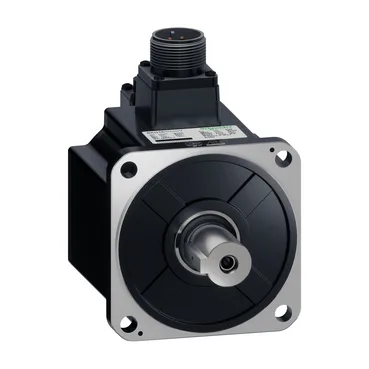
1.5 kW at 3000 rpm — continuous torque and the load it drives
The BEH18LH1533MA6D delivers 4.77 N.m nominal torque at 3000 rpm from a 380 V three-phase supply, rated for 1500 W continuous output. That torque constant of 0.984 N.m/A at 40 °C means the servo drive's current loop has a direct, linear mapping from commanded current to shaft torque — no lookup-table corrections needed across the operating range. Peak stall torque reaches 14.31 N.m — roughly 3× the continuous rating — for acceleration bursts during indexing or pick-and-place moves. The 10-pole rotor keeps torque ripple at a frequency the drive's notch filter can suppress without sacrificing bandwidth.
17-bit absolute feedback — no homing cycle needed
The magnetic multiturn encoder provides 17-bit absolute position data over the full travel range. On power-up the drive knows the shaft position without a reference run — critical for applications where a homing move would collide with tooling or waste cycle time. Back EMF constant is 65.28 V/krpm at 40 °C. At 3000 rpm the generated voltage reaches 196 V — the drive's DC bus must stay above this to maintain current control authority. The 4.86 A continuous stall current sets the I²t thermal limit for the winding; sustained overloads above this value will trip the motor PTC or the drive's motor model.
IP67 and Asian flange — mounting constraints for wet or tight panels
IP67 rating means the motor body and connector are sealed against hose-directed water and dust ingress. This fits food-and-beverage washdown zones or outdoor conveyor sections where a standard IP54 servo would fail the quarterly sanitation cycle. The 100 mm Asian-standard flange uses four 9 mm mounting holes on a 100 mm bolt circle — verify the mating face pattern if replacing a NEMA-frame motor. Without a holding brake, this motor relies entirely on the drive's holding torque or an external brake for vertical-axis load support at power-down. The 24 mm shaft with an 8 mm parallel key is standard for the 1.5 kW class; max radial force is 686 N and max axial force is 196 N — bearing limits that constrain belt tension and lead-screw thrust.
No direct successor or cross-reference within the Lexium 18 family — this variant is the one specified.