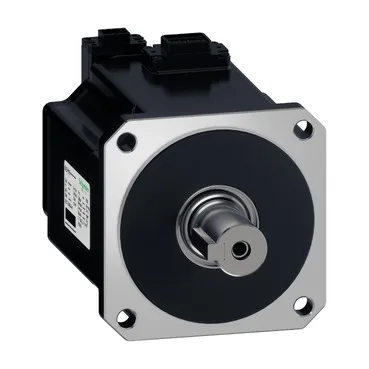
750 W servo with holding brake for Lexium 18 drives
The BEH18MF0733MF5C is a 750 W servo motor from the Lexium 18 range, designed for direct mating with Schneider Electric's Lexium 18 drive series. It delivers 2.39 N.m nominal torque at 3000 rpm from a 220 V single-phase supply, with a peak stall torque of 8.37 N.m for short-duration acceleration moves. The integrated holding brake (3.2 N.m) holds the load at zero speed without power to the motor windings — essential for vertical-axis applications where the load must not drift when the drive is disabled. IP67 rating on the motor body means it withstands washdown environments; the shaft seal and connector interface are the wet-end barriers, not the housing threads.
Torque, speed, and feedback for axis sizing
Nominal torque of 2.39 N.m at 3000 rpm (continuous stall torque identical at 2.39 N.m) sets the continuous-duty operating point. Peak stall torque of 8.37 N.m gives a 3.5× overload margin for acceleration and deceleration transients — typical for pick-and-place or indexing moves. Maximum mechanical speed is 6000 rpm, but the nominal speed is 3000 rpm; the torque constant is 0.509 N.m/A at 40 °C, so the continuous stall current of 4.7 A maps to the 2.39 N.m continuous torque. Maximum permanent current is 16 A, defining the peak torque ceiling. The 17-bit magnetic multi-turn encoder (131072 points/turn) provides absolute position feedback over multiple shaft revolutions without a battery — the multi-turn count is retained magnetically, so the axis knows its position after a power cycle without homing.
Mounting, shaft, and environmental fit
Asian standard flange with 80 mm square face and four mounting holes. The shaft is 19 mm diameter with a parallel key, 35 mm shaft length — this is a standard metric shaft size for 750 W class servos, mating with common coupling and pulley bores. Maximum radial force (Fr) is 392 N, maximum axial force (Fa) is 147 N — these are the bearing load limits at the shaft centreline. Exceeding them reduces bearing life; a belt drive or overhung load must be sized within these limits.