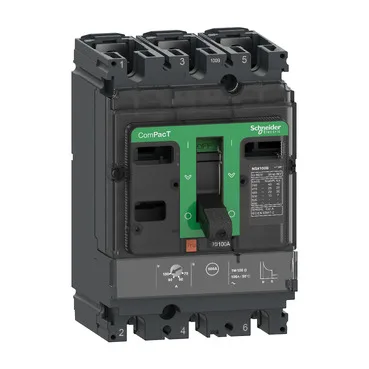
It's built for distribution duty in panelboards and switchboards — the 25 A rating at 50 °C means it carries that current continuously without derating in a warm enclosure, and the TM-D trip gives you fixed thermal overload protection plus fixed magnetic short-circuit protection (L and I curves). The 25 kA Icu at 415 V AC is the interrupting capacity you coordinate downstream gear against; at 220/240 V it breaks 40 kA, so it handles high-fault utility feeds on the secondary side of a 480/277 V transformer.
For a 25 A feeder, this gives you headroom against most industrial service-entrance faults; you'd coordinate it with a higher-rated upstream device (say a 50 kA or 65 kA NSX frame) to get full selectivity. At 440 V the Icu drops to 20 kA, and at 500 V to 15 kA — so if your system runs at 480 V, verify the available fault current stays under 15 kA.
The 105 mm width × 161 mm height × 86 mm depth fits standard MCCB cutouts; connection pitch is 35 mm between poles. Front-connect terminals on both line and load sides simplify busbar or cable landing in a panel.
Suitability for isolation is confirmed per that standard — you can use it as a visible-break disconnect in a distribution circuit. Overvoltage category III applies — it's rated for fixed installation downstream of the service entrance. Electrical durability is 50,000 cycles at 440 V at rated current, and 30,000 cycles at In; mechanical durability is 50,000 cycles.