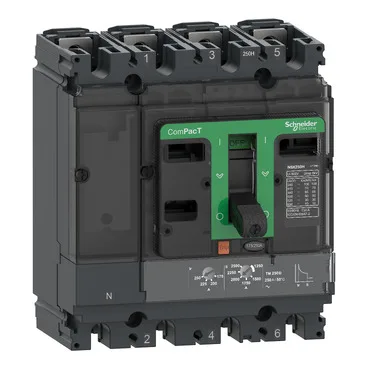
It's a 4-pole (4P) thermal-magnetic unit, rated 32 A at 50 °C, with a breaking capacity of 25 kA Icu at 380/415 V AC conforming to EN/IEC 60947-2.
What the breaking capacity means on your panel
In a typical 415 V distribution board, that covers most downstream faults unless you're feeding a high-capacity transformer bank. The rating drops to 20 kA at 440 V and 15 kA at 500 V — so if your system runs at 480 V phase-to-phase, the available fault current needs to stay under 15 kA. The breaker carries a Category A utilisation class (EN/IEC 60947-2), meaning it's not intended for cascading or selective coordination with other breakers in a series — each fault is cleared at the first device upstream.
Front connections top and bottom, with a 35 mm connection pitch. The 4P unit with neutral on the left (4D configuration) takes up 140 mm width on the panel, 161 mm height, 86 mm depth. IP40 front face, IK07 impact rating. Overvoltage category III — suitable for fixed-installation distribution boards downstream of the main service entrance.
No direct successor part number is published; the NSX100B frame covers a range of trip ratings, so if you need a different amp rating the same physical breaker accepts interchangeable TM-D trip units.
Mechanical endurance is 50,000 cycles; electrical endurance varies with load — 50,000 cycles at 440 V at half rated current, 30,000 at full rated current. No earth-leakage protection built in — the TM-D is a straight thermal-magnetic unit; add a Vigi module externally if you need GFCI.