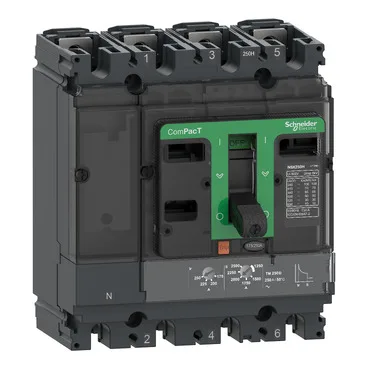
The 25 kA Icu at 415 V AC (breaking capacity code B) means it can safely interrupt a fault current up to 25,000 A at that voltage without welding or rupturing — sufficient for most distribution panels fed by a 500 kVA transformer. At 240 V AC the same breaker handles 40 kA Icu, so it also covers high-fault service-entrance positions where the utility short-circuit capacity is higher. The TM-D trip unit provides fixed thermal (L) overload protection and fixed magnetic (I) short-circuit protection — no interchangeable rating plugs, no electronic adjustments. For a BOM line this means the 50 A setting is locked at the factory; if the load calculation later requires 63 A, the entire breaker or at least the trip unit must be swapped.
Compliance documentation is straightforward: the breaker is designed and tested to EN/IEC 60947-2, carries IP40 finger protection (conforming to IEC 60529), IK07 impact resistance (conforming to IEC 62262), and is suitable for isolation per the same standard.
Dimensions are 161 mm high by 140 mm wide by 86 mm deep — a compact footprint for a 4-pole 50 A MCCB, leaving room for cable bending radius below the front-connected terminals. Electrical endurance is rated at 50,000 cycles at 440 V at half rated current (In/2), and 30,000 cycles at full rated current (In). Mechanical durability is 50,000 cycles. For a panel that sees frequent switching — such as a compressor or pump start-stop several times per shift — these figures give a realistic service life before contact wear becomes a concern. The toggle control is manual; no motor operator or shunt trip is included in this base variant.