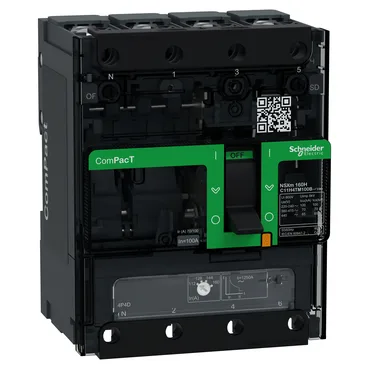
Rated per EN/IEC 60947-2, utilisation category A, so it's intended for distribution duty, not direct motor switching. The TM-D trip is thermal-magnetic — thermal element for overload, magnetic for short-circuit — with no electronic adjustment. That makes it a fixed-setting breaker: what you see (125 A at 40 °C) is what you get. Pollution degree 3 (IEC 60664-1) and overvoltage category III. IP40 front face, IK07 impact resistance. 12-module width (108 mm), 80 mm depth. Front connection via compression lugs or busbars, 35 mm pitch with spreaders, 27 mm without.
Lifecycle stage is current. This is an active catalog item in Schneider's ComPacT NSXm line. No phase-out or last-time-buy notice.
What the ratings mean in the panel
That 40 °C reference matters: if the panel ambient runs hotter (say 50 °C), the breaker must be derated per the manufacturer's curve; the 125 A figure is not a hard limit at elevated temperature. For selectivity coordination downstream, the H rating gives headroom over lower-performing (S or F) frames in the same panel. 20,000 electrical cycles at 440 V at half rated current (In/2), 10,000 at full rated current — mechanical durability matches at 20,000 cycles. That's typical for distribution breakers; not high-cycle like a contactor, but adequate for a panel that sees occasional switching. Altitude derating applies above 2000 m — up to 5000 m with derating. Relative humidity 0–95 % non-condensing. Local signalling flag (green) indicates presence of auxiliary contacts. No earth-leakage protection built in; that would require an external Vigi module or a separate RCD.