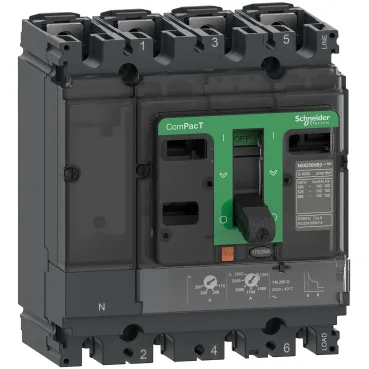
What the 125 A thermal-magnetic rating means for your panel
The TM-D provides L (thermal) protection for overloads and I (magnetic) protection for short-circuits, both adjustable within the trip unit's range. For a 125 A continuous load, this breaker clears fault currents up to 85 kA Icu at 240 V AC and 36 kA Icu at 415 V AC — that's the interrupting capacity at the panelboard's fault level, not the load current. The 4-pole configuration (3 phases + switched neutral) suits distribution boards where neutral isolation is required.
Breaking capacity across common voltages
The F breaking capacity code means 36 kA Icu at 415 V AC, but the actual rating varies by system voltage: 85 kA at 240 V AC, 35 kA at 440 V AC, 30 kA at 500 V AC, 22 kA at 525 V AC, and 8 kA at 690 V AC. For UL 60947-4-1 applications, it delivers 85 kA at 240 V AC, 35 kA at 480 V AC, and 15 kA at 600 V AC. The 125 A frame (NSX250F) means the breaker's mechanical structure supports up to 250 A — the 125 A trip unit sets the actual protection threshold. This matters when you're sourcing a spare: the frame stays the same if you later need a higher trip rating.
Front connections top and bottom — no rear-access requirement, which simplifies gland-plate layout and busbar routing. Overvoltage category III suits fixed-installation distribution boards.
Rated for 20,000 mechanical cycles and 20,000 electrical cycles at 440 V In/2 (half rated current). At full rated current (440 V In), electrical durability drops to 10,000 cycles; at 690 V In, it's 5,000 cycles. That's typical for a distribution-grade MCCB — not a switching device, but fine for infrequent manual isolation.