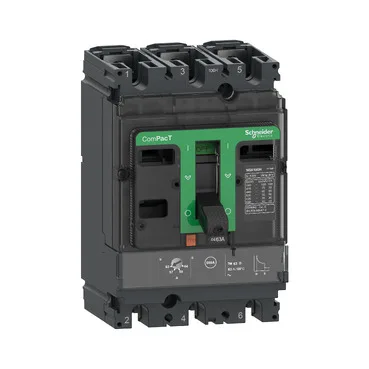
It's built to EN/IEC 60947-2, which covers the construction and testing of low-voltage switchgear — the standard that defines Icu (ultimate breaking capacity) and Ics (service breaking capacity) ratings. The H breaking capacity code means 70 kA Icu at 415 V AC, and the full curve runs from 100 kA at 240 V down to 10 kA at 690 V, so it handles high-fault panels without cascading upstream.
The 100 kA Icu at 220/240 V AC is the headline number, but the rating that governs most distribution panels is the 70 kA at 380/415 V — that's where you coordinate with upstream and downstream devices. The 10 kA at 690 V is a derated ceiling for special applications. For a 160 A feeder on a 415 V system, this breaker gives enough SCCR headroom to avoid a series-rated compromise.
Front connections top and bottom simplify busbar or cable routing in a panel. The 105 mm width, 161 mm height, and 86 mm depth fit standard MCCB cutouts. IP40 enclosure protection means it's suited for clean indoor panels — not washdown environments.
Trip unit and protection characteristics
Rated 160 A at 50 °C, with power dissipation of 11.78 W per pole — relevant for thermal management in a sealed enclosure. Electrical durability is 20,000 cycles at 440 V In/2 and 10,000 cycles at full rated current, so it's a distribution-grade breaker, not a switching device for frequent motor starts.