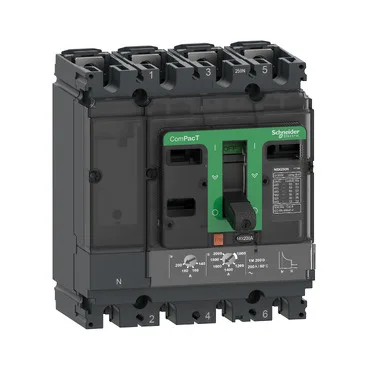
Its 50 kA Icu at 380/415 V AC (IEC 60947-2) gives you a full-rated short-circuit current that matches the standard 415 V industrial supply — no derating needed for most panel main or feeder applications at that voltage level. At 220/240 V the same breaker delivers 90 kA Icu, and at 690 V it still holds 10 kA, so the frame scales across distribution voltages without swapping hardware. The TM-D trip provides L (thermal overload) and I (magnetic short-circuit) protection curves, which is the standard thermal-magnetic characteristic for distribution feeders where you need adjustable magnetic pickup but no electronic fine-tuning.
Integration and mounting — backplate, horizontal or vertical
The breaker mounts to a backplate (not DIN rail) and accepts both horizontal and vertical orientations with flat-on-back fixing.
Selectivity and coordination — what the breaking capacity table tells you
The IEC 60947-2 breaking capacity table is the key coordination tool: at 415 V the 50 kA Icu matches the typical transformer secondary fault level for a 1600 kVA unit at 5 % impedance. If your available fault current is higher (e.g., 65 kA at 415 V), you step up to the NSX250H or NSX250L frame — the N frame here is sized for standard 50 kA installations. The 10 kA Icu at 690 V is adequate for 690 V distribution only where the transformer impedance or cable run limits the fault current below that threshold.
Electrical endurance — cycles for switching duty
Mechanical durability is rated at 20,000 cycles, and electrical durability at 440 V In is 10,000 cycles (20,000 at In/2). At 690 V the electrical endurance drops to 5,000 cycles at In/2 and 5,000 at In. These figures matter if the breaker is used for switching rather than backup-only protection — for frequent load switching, the 440 V rating gives the longest service life.