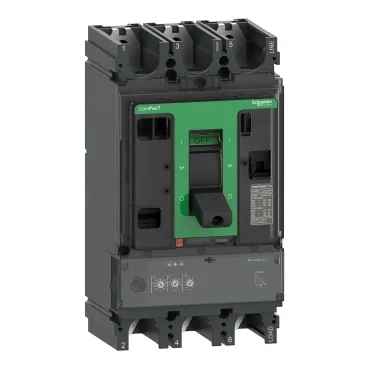
Trip unit and protection — what L, So, I means on the MicroLogic 2.3
The C63V32D630: The MicroLogic 2.3 provides three protection functions: L (long-time overload), So (short-time short-circuit with fixed delay), and I (instantaneous short-circuit). The So function gives a fixed time delay for selective coordination downstream; the I function clears bolted faults instantly. The trip unit is electronic, so it holds its calibration across temperature better than a thermal-magnetic unit.
Mounting and integration — backplate, front connections, 6 accessory slots
Both line and load connections are front-facing.
Durability and electrical life — cycles that matter for a distribution breaker
Mechanical durability is 15,000 cycles — the breaker can be opened and closed that many times before mechanical wear is expected. Electrical durability depends on the load: 8,000 cycles at 440 V at half rated current (In/2), 4,000 cycles at 440 V at full In, 6,000 cycles at 690 V at In/2, and 2,000 cycles at 690 V at full In. For a distribution breaker that rarely operates under load, these numbers are generous; the limiting factor is usually the number of fault interruptions, not routine switching. The utilisation category is Category A (non-selectively coordinated for short-circuit), meaning it's intended for standalone protection rather than cascaded selective schemes.
Environmental limits — altitude, humidity, and operating range
Rated for 0 to 2000 m altitude without derating; above that up to 5000 m with derating. Relative humidity 0 to 95% non-condensing.