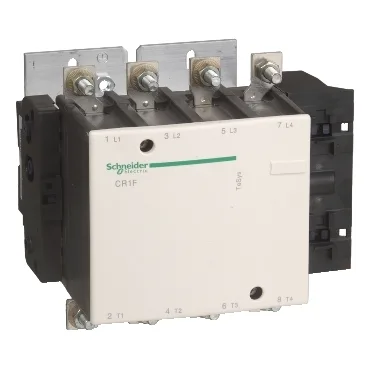
The magnetic latching mechanism means the coil only draws power during the transition; once latched, it holds position without continuous coil current, which cuts standby losses and keeps the coil cool in enclosed panels. Its headline rating is 265 A in AC-3 duty (motor starting), so it handles induction motors up to that current — roughly 160 kW at 690 V or 150 hp at 480 V under UL/CSA. The utilisation categories span AC-1 (resistive), AC-3 (squirrel-cage motor start/run), and AC-4 (plugging/inching), so it covers both steady-state and demanding reversing applications. The control circuit is 380 V AC 50/60 Hz, with latching and unlatching limits of 0.85 to 1.1 Uc. Coil consumption peaks at 1800 VA during latching, dropping to 12 VA unlatching — that transient load matters when sizing the control transformer.
Mounts on a notched AM1-EC rail or directly to a panel. Dimensions are 8.4 in deep by 9.6 in wide by 8.0 in tall — a substantial footprint that needs clearance for cable entry and heat dissipation. Terminals accept lugs, ring terminals, or bars up to 240 mm², with a tightening torque of 35 N·m on the power connections. The TH protective treatment adds resistance to tropical humidity, which matters for non-climate-controlled plant floors.
Electrical performance and protection
Rated insulation voltage is 1000 V per IEC 60947-4 and BS 775, with a 1500 V group C rating per VDE 0110. That gives headroom for 690 V systems and confirms the contactor can be used in 1000 V circuits with proper coordination. Breaking capacity is 2450 A at 440 V, tapering to 800 A at 1000 V — the contactor can interrupt fault currents within those limits, but upstream fusing or a breaker must handle the full prospective fault. Associated fuse ratings are 315 A aM or 400 A gG at ≤440 V for the power circuit. Making capacity is 2940 A, so it can close into a stalled motor or shorted load without welding contacts — that's the peak inrush it can handle once. Average impedance per pole is 0.32 mΩ at 350 A, which keeps voltage drop and heat low during continuous current.
Standards compliance includes VDE 0660, NF C 63-110, JEM 1038, BS 5424, and IEC 60947-4. Motor power HP ratings are given in UL/CSA terms.