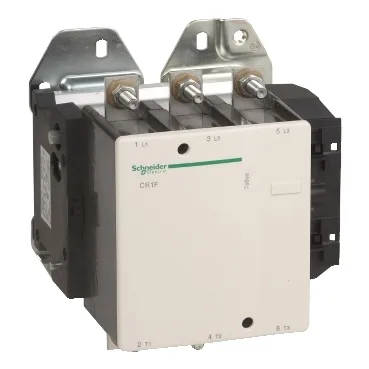
The Schneider CR1F500Q7 is a TeSys F magnetic latching contactor — a 3-pole device that uses a pulse on the coil to latch closed and a separate pulse to unlatch, so it holds its state without continuous coil power. That makes it the right choice for applications where you want to avoid coil heating or need the contactor to stay closed through a control-power dip. It's rated for motor control (AC-3, AC-4) and resistive loads (AC-1), with a rated operational current of 500 A in AC-4 duty at 440 V. The coil is wound for 380-400 V AC 50/60 Hz, and the latching coil draws 1800 VA while the unlatching coil draws 13 VA — a big difference that matters when sizing the control transformer or pulse capacitors. Operating time is 40-80 ms to latch, 50-100 ms to unlatch.
The rated operational current of 500 A in AC-4 (the toughest motor starting category, with inrush and plugging) tells you this contactor handles heavy reversing or jogging duty. In AC-3 (normal start-run), the current rating is higher — 700 A at 440 V — so it comfortably covers a 335 kW motor at 690 V or a 250 kW motor at 400 V. The motor power table covers voltages from 220 V to 1000 V, so you can match it to the line voltage without recalculating. The associated fuse recommendation is 500 A aM or 800 A gG — that's the upstream protection the contactor expects to coordinate with. Power dissipation per pole is 45 W in AC-3 and 88 W in AC-1 — that's the heat you need to vent from the enclosure. At 120 cycles per hour maximum operating rate, it's not a high-speed switching device; it's built for sustained motor duty.
Certified to EN/IEC 60947-1, EN/IEC 60947-4-1, JIS C8201-4-1, UL 60947-4-1, and CSA C22.2 No 60947-4-1. That covers the main industrial control standards for Europe, Japan, North America, and Canada. The rated insulation voltage is 1000 V per IEC and BS, 1500 V per VDE 0110 group C.