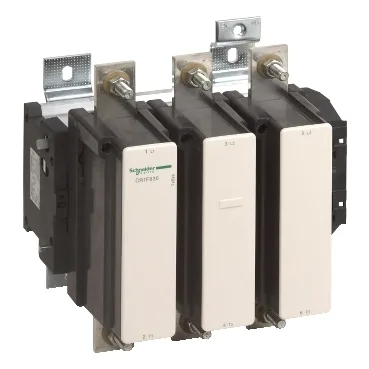
The CR1F630FZ7 is a Schneider Electric TeSys F magnetic latching contactor, 3-pole (3 NO), rated for 630 A operational current in AC-4 duty at <= 440 V, 40 °C. That AC-4 rating — 335 kW at 400 V AC — governs plugging and inching of squirrel-cage motors, the hardest switching duty for a contactor because it makes and breaks locked-rotor current. The 630 A frame also carries AC-1 (resistive) and AC-3 (motor start/run) utilisation categories, so it handles furnace banks or conveyor drives, but the AC-4 number is the one that decides fit for reversing or jogging applications. Rated breaking capacity reaches 6300 A at 220...440 V, and the rated making capacity (Irms) is 6740 A. Short-time withstand current (Icw) holds 5.05 kA for 10 seconds at 40 °C — enough headroom for selective coordination with upstream moulded-case breakers. Insulation voltage (Ui) is rated 1000 V per IEC 60947-4 and BS 775, and 1500 V per VDE 0110 group C.
Control circuit and latching behaviour
The coil is 110 V DC, low-consumption type. Latching consumes 620 W DC; unlatching draws 45 W DC. Operating time is 40...80 ms for latching, 50...100 ms for unlatching. The control voltage limits are 0.85...1.1 Uc for both latching and unlatching, so the coil holds in at 93.5 V DC and drops out predictably below that. This is a magnetic latching contactor — it uses a permanent magnet to hold the contacts closed after the coil pulse, so it does not require continuous coil power to stay engaged. That makes it suitable for battery-backed or UPS-fed circuits where sustained coil draw is a concern. Average impedance per pole is 0.12 mOhm at Ith 1000 A, 50 Hz. Power dissipation per pole runs 48 W in AC-3 and 120 W in AC-1 — the resistive load curve generates more heat because of the longer arcing time on break. Mechanical durability is 1 million cycles; maximum operating rate is 120 cycles per hour at 40 °C.
Mounting, connections, and environment
Power circuit connections are bolted bars — two 60 x 5 mm bars per pole. Tightening torque is 513.3 lbf.in (58 N.m). The contactor is a panel-mount unit, not DIN-rail; the bolted bus bars suit switchboard or motor control centre (MCC) backplates where high-current bus runs are standard. Dimensions are 12.2 in (309 mm) wide, 12.0 in (304 mm) high, 10.04 in (255 mm) deep. Ambient air temperature for operation is 5...158 °F (-15...70 °C); storage range is -76...176 °F (-60...80 °C). Operating altitude is 9842.52 ft (3000 m) without derating. The protective treatment is TC (tropicalised coating) for humidity and corrosive atmospheres.