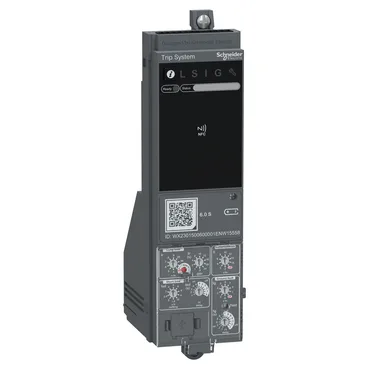
What this control unit does in the panel
The ENW11703 is a Trip System 6.0s microprocessor-based control unit for the Schneider Electric EasyPact NW range of air circuit breakers. It handles LSIG protection — overload (long-time), short-time short-circuit, instantaneous short-circuit, and earth fault — across a trip unit rating of 630 to 6300 A, with the actual setting dialed in via 10-position adjustments for Ir, Isd, and ground-fault pickup. The unit logs alarm, event, and trip data, and carries thermal memory so the breaker remembers prior heating when reclosed after a trip. Rated operational voltage is 690 V AC at 50/60 Hz per IEC 60947-2, which covers most industrial distribution voltages up to 690 V line-to-line. The drawout mounting means this control unit slides into the breaker cradle without disturbing the power connections — a field-service swap in minutes, not hours.
Protection coordination and settings
The LSIG scheme gives four independent protection curves. Long-time pickup (Ir) adjusts from 0.4 to 1 x In in 10 steps, with a delay range of 0.5 to 24 seconds at 6 x Ir. Short-time pickup (Isd) also has 10 settings, delay adjustable 100 to 600 ms. Instantaneous pickup spans 2 to 15 x In, and can be switched Off for selective coordination downstream. Ground-fault pickup is adjustable in 10 steps as well. That level of adjustability lets the engineer dial in selectivity with downstream breakers without swapping trip units. Neutral protection is configurable: 3D (no neutral protection), 3D + N/2 (half-rated neutral), or 4D (full neutral protection). The neutral position is left-side, which matches the standard EasyPact NW drawout cassette layout.
Communication and diagnostics
The control unit has built-in NFC for wireless peer-to-peer communication via a smartphone app, plus a USB Type-C port for direct wired connection. No separate communication module is needed for local parameter readout or event retrieval. The front-panel status LED shows green, red, and orange health status bars plus a green ready indicator — a quick visual check tells the technician whether the unit is healthy, tripped on fault, or in a warning state. Fault indication covers short-circuit, overload, earth fault, and internal fault. The I button on the front panel provides manual trip testing. Battery is a lithium non-rechargeable cell that powers the trip unit logic and event logging when the breaker is open.
Environmental and physical fit
The drawout mounting means the control unit is swapped without de-energizing the main bus — the breaker is racked to the test or disconnected position, the control unit slides out, and the replacement clicks in. No rewiring of power connections.