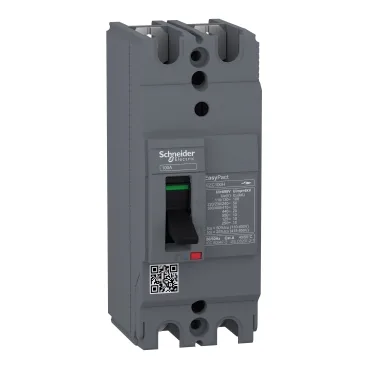
Breaking capacity is the key selection figure here. At 125 V DC single-pole it clears 10 kA Icu per IEC 60947-2; at 250 V DC 2-pole it also clears 10 kA. On AC, the 380…400 V 50/60 Hz rating is 30 kA Icu, and at 220…240 V it reaches 50 kA Icu. The unit is front-connected top and bottom, mounts fixed to a backplate, and uses a toggle for manual control. Positive contact indication gives a visual confirmation of the contact position independent of the toggle mechanism — useful during panel commissioning when you need to verify isolation without assuming the handle position.
Dimensions are 130 mm high, 50 mm wide, 60 mm deep. The 2-pole configuration protects both poles (2t) with no neutral protection. If your circuit requires a switched neutral or a 4-pole break, this is not the variant. For a straightforward 2-wire distribution feed — single-phase or DC — it fits without extra wiring complexity.
The breaker is certified to JIS C8201-2-2, EN/IEC 60947-2, GB/T 14048.2, and EN/IEC 60947-1. Rated insulation voltage is 690 V AC, operational voltage is 550 V AC or 250 V DC — the DC rating covers common 125 V and 250 V battery or rectifier circuits. The 16 A rating at 40 °C is the standard reference; at 50 °C the trip unit still carries 16 A, so no derating is needed up to that temperature for the trip unit itself — though the overall breaker rating at 40 °C is the one to use for NEC or IEC cable sizing.