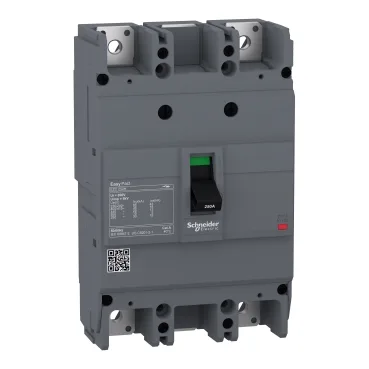
The Schneider Electric EZC250H2250 is a 2-pole EasyPact EZC250H molded-case circuit breaker (MCCB) with a TM-D thermal-magnetic trip unit rated 250 A at 40 °C. At 550 V AC it still interrupts 10 kA, so it can sit on a 480 V line in North America or a 500 V industrial bus in Europe without coordination problems.
The Icu varies with applied voltage — 85 kA at 240 V AC, 36 kA at 415 V AC, 25 kA at 440 V AC, 10 kA at 550 V AC. That's typical for a compact MCCB: the arc-quenching chamber has a fixed energy limit, so the same hardware clears more current at lower voltage. For a 480/277 V wye service the 36 kA at 400–415 V AC is the relevant figure; derate to the 25 kA at 440 V AC if the system runs at 480 V phase-to-phase. The DC ratings — 30 kA Icu at 125 V DC 1P and 250 V DC 2P — let it serve as a battery or UPS disconnect where DC fault currents are high.
Fixed backplate mount — no DIN-rail adapter, so it bolts directly to a panel backplate. The 105 mm width × 165 mm height × 60 mm depth fits a standard MCCB cutout; the 35 mm connection pitch aligns with busbar or cable-lug spacing on a distribution block. Ambient operating range of –25 to 70 °C covers most electrical rooms; storage range of –35 to 85 °C handles warehouse extremes.
Designed and tested to GB/T 14048.2, EN/IEC 60947-1, and EN/IEC 60947-2 — the global standard for low-voltage switchgear and controlgear. Suitability for isolation per IEC 60947-2 confirms that with the toggle in the OFF position, the breaker provides a visible break — important for lockout/tagout procedures. Mechanical durability of 10,000 cycles is standard for a distribution MCCB; expect electrical life to be lower under full rated load.