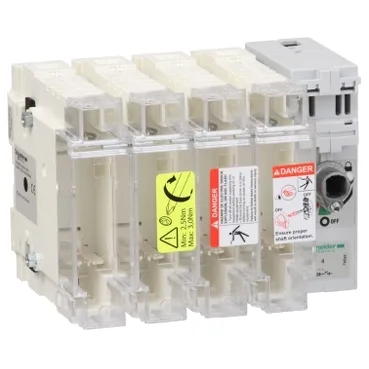
It's built to IEC 60947-3, the standard for disconnectors and switch-disconnectors, meaning it provides visible-break isolation plus load-breaking capability in one package. Rated operational current (Ie) varies by duty: 125 A at 400 V and 500 V in AC-23A/B, and 100 A at 690 V AC-23A/B. For DC applications, it's rated 100 A at 440 V with two poles in series per phase for both DC-23A and DC-23B duty cycles. Rated operational power reaches 63 kW at 400 V, 90 kW at 500 V, and 80 kW at 690 V — so it handles motor loads across common industrial voltage levels, not just resistive heating banks.
Making capacity is 1 kA at the same conditions, meaning it can close onto a fault without welding contacts. Short-circuit withstand rating is 20 kA — the switch can survive that level of through-fault current when protected by upstream fuses or breakers, without needing to interrupt it itself. The rated short-circuit making capacity (Icm) is 100 kA at 400 V with gG fuse protection, which is the peak asymmetrical current it can close into.
Integration and physical fit
Mounts to a plate — not DIN rail — so plan for a drilled backplate in the enclosure. Dimensions are 184 mm wide, 162 mm high, 116 mm deep. Accepts power circuit connections via bars (20 mm²) or ring-terminal lugs (35 to 95 mm²). Tightening torque on the power terminals is 12 N·m. Fuse size is 22 x 58 mm, type NFC — a standard European fuse format. The switch accepts four protected poles (4t), with 4 NO contacts. Operating handle can be mounted on the external right side or external frontal position, giving flexibility in panel layout. IP20 with terminal cover fitted — that's finger-safe but not washdown-rated. Fire resistance is 850 °C on the fuse cover and 960 °C on the body, per IEC 60695-2-1.