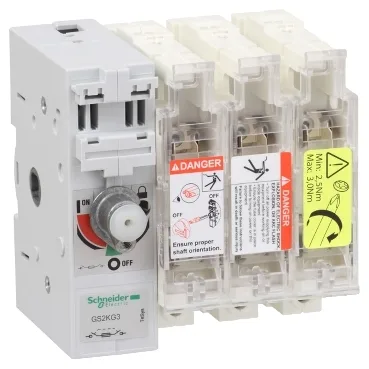
It accepts NFC-type fuses in the 22x58 mm size, making it a fused disconnect for motor branch circuits or distribution feeders where overcurrent protection is integrated into the switch itself. Rated operational current reaches 125 A at 400 V under AC-23A and AC-23B duty, and 100 A at 690 V in the same categories. For DC applications, it handles 100 A at 440 V with two poles in series per phase. It is designed for plate mounting, with an external left-side operating handle. The power circuit accepts bars up to 20 mm² or lugs/ring terminals from 35 to 95 mm², torqued to 12 N·m. IP20 with the terminal cover fitted, so it belongs inside a panel, not exposed to washdown.
The 125 A rating at 400 V AC-23A/B is the headline number for motor switching: AC-23A covers occasional switching of motors and other highly inductive loads, while AC-23B adds the requirement for infrequent switching under fault conditions. The 20 kA short-circuit withstand rating (with appropriate upstream protection) gives coordination headroom. Rated operational power reaches 63 kW at 400 V, 90 kW at 500 V, and 80 kW at 690 V — these are the motor sizes this switch can handle at those voltages, assuming the fuse is correctly selected. Mechanical durability is 10,000 cycles; electrical durability varies by duty: 1000 cycles under AC-23A or DC-23A, dropping to 200 cycles under the more demanding AC-23B or DC-23B. This is a switch-disconnector, not a contactor — it is not designed for frequent switching under load. Use it for isolation and infrequent motor starting, not for continuous duty cycling.
The GS2KG3 is designed and tested to IEC 60947-3, the standard for switches, disconnectors, switch-disconnectors and fuse-combination units. Fire resistance is rated at 850 °C for the fuse cover and 960 °C for the body, per IEC 60695-2-1.